Showing posts with label miami-dade police department. Show all posts

Wednesday, July 05, 2023

Former Miami-Dade Police Officer Pleads Guilty to COVID-19 Relief Fraud


MIAMI – Samuel Harris, a former police officer with the Miami-Dade Police Department (MDPD), has pleaded guilty to wire fraud in connection with fraudulent applications for COVID-19 relief funds. The plea was entered in Miami before U.S. District Judge Robert N. Scola Jr.

According to the facts presented during the change of plea, Harris, who owned and served as the president of Oregen Digital, Inc., submitted false and fraudulent applications for a Paycheck Protection Program (PPP) loan, an Economic Injury Disaster Loan (EIDL), and an EIDL advance. On June 29, 2020, Harris submitted a fraudulent PPP loan application claiming that Oregen had 10 employees with a monthly payroll exceeding $50,000. To support the application, he submitted a fraudulent IRS Form W-3 stating that Oregen had paid over $602,000 in wages to its employees in 2019. As a result, Harris obtained a $125,579 PPP loan from an SBA-approved lender based in Georgia.

Harris also admitted to submitting a false and fraudulent EIDL application on June 30, 2020, on behalf of Oregen. The application falsely claimed that Oregen had gross revenues of over $859,000 and 10 employees in the twelve-month period before January 31, 2020. Consequently, Oregen received a $10,000 EIDL advance and $149,900 in EIDL loan proceeds from the Small Business Administration (SBA).

Harris is scheduled for sentencing on September 25, facing a maximum sentence of up to 20 years in prison.

U.S. Attorney Markenzy Lapointe for the Southern District of Florida, Special Agent in Charge Jeffrey B. Veltri of the FBI Miami Field Office, Special Agent in Charge Matthew D. Line of the IRS Criminal Investigation Miami Field Office, and SBA OIG’s Eastern Region Special Agent in Charge Amaleka McCall-Brathwaite, U.S. Small Business Administration Office of Inspector General (SBA OIG), Investigations Division’s Eastern Region, announced the guilty plea.

The FBI’s Miami Area Corruption Task Force, which includes officers from the Miami-Dade Police Department’s Professional Compliance Bureau, IRS-CI, and SBA OIG, conducted the investigation. U.S. Attorney Lapointe expressed gratitude to the Miami-Dade County Office of Inspector General for their assistance. Assistant U.S. Attorney Edward N. Stamm is prosecuting the case.

The COVID-19 relief funds were authorized by the Coronavirus Aid, Relief, and Economic Security (CARES) Act enacted in March 2020. The relief measures, including the PPP and EIDL, aimed to provide emergency financial assistance to individuals and businesses affected by the COVID-19 pandemic.

To combat and prevent pandemic-related fraud, the Attorney General established the COVID-19 Fraud Enforcement Task Force on May 17, 2021. This task force, in collaboration with various government agencies, investigates and prosecutes domestic and international criminal actors involved in COVID-19-related fraud. The Department of Justice's Southern District of Florida's U.S. Attorney's Office was selected in September 2022 to lead one of three national COVID-19 Fraud Strike Force Teams.

Individuals with information related to COVID-19 fraud can report it to the Department of Justice's National Center for Disaster Fraud (NCDF) Hotline at 866-720-5721 or through the NCDF Web Complaint Form on their website.

For more information on the Department's response to the pandemic, visit the official Justice Department's website at https://www.justice.gov/coronavirus.

Sunday, July 22, 2012

Arrest of Bank Robbery, Carjacking Suspect Pedro Luis Valdes


The FBI announces the arrest of Pedro Luis Valdes, 48, of Miami, Florida, for his alleged involvement in two recent bank robberies and a carjacking involving a 3-year-old child (the child was returned safely).

The arrest was made without incident by the FBI, U.S. Secret Service, Miami-Dade PD, Hialeah PD, City of Miami PD, Miami Beach PD, and the South Florida Violent Crime Fugitive Task Force (SFVCFTF) around 9:45 p.m. last night at 3141 SW 8th Street in Miami, Florida.

Valdes is in federal custody and is expected to face federal charges. It is anticipated that his initial appearance will be today (Friday) in federal court in Miami.

The FBI, the U.S. Secret Service, Miami-Dade PD, Hialeah PD, City of Miami PD, and all members of the SFVCFTF continue their investigation. No further information will be released at this time.

Sunday, June 10, 2012

FBI Releases Photographs of a Vehicle of Interest in Connection with Coral Gables Fire


Seeks Public Assistance for Information

MIAMI—The FBI is seeking the public’s assistance to identify a vehicle of interest or for any information possibly related to the fire in a travel agency at 815 Ponce De Leon Boulevard in Coral Gables, Florida, during the early morning hours of April 27, 2012.

A fire marshal report indicated that the fire was deliberately set.

The joint investigation of the arson includes the Bureau of Alcohol, Tobacco, Firearms, and Explosives; the Coral Gables Fire Department; and the Division of State Fire Marshal Bureau of Fire and Arson Investigation. The Miami-Dade Police Department and city of Miami Police Department have also provided support during this investigation.

The public is being asked for information that may lead investigators to a suspect or the car of interest. Anyone with information should contact the FBI at (305) 944-9101, ATF at (305) 597-4800, Coral Gables Fire Department at (305) 471-TIPS, or State Fire Marshal at 877-662-7766.

On April 27 at approximately 3:30 a.m., Coral Gables firefighters responded to reports of a building fire at 815 Ponce De Leon Boulevard. Firefighters had the fire under control within minutes. There were no injuries.

No further information is available at this time.

Friday, January 13, 2012

Shooter in Brink’s Armored Car Robbery Sentenced to Life in Prison

Wifredo A. Ferrer, United States Attorney for the Southern District of Florida, and John V. Gillies, Special Agent in Charge, Federal Bureau of Investigation (FBI), Miami Field Office, announce today’s sentencing of Nathaniel Moss, 33, of Miami Gardens, FL, for his involvement in the October 1, 2010 robbery and fatal shooting of Alejandro Nodarse Arencibia, a messenger for Brink’s, an armored car company. U.S. District Judge James I. Cohn sentenced Moss to life plus 20 years in prison.

On October 14, 2011, Moss pled guilty to robbery and conspiracy to commit robbery, in violation of Title 18, United States Code, Section 1951, and the use of a firearm in the commission of the robbery and causing death through use of a firearm, in violation of Title 18, United States Code, Sections 924(c) and 924(j).

The robbery took place around noon on Friday, October 1, 2010, outside the Bank of America on Miramar Parkway, in Miramar, Florida. According to documents filed with the court, at approximately 11:55 a.m., Arencibia (the victim), a Brink’s armored car messenger, was delivering a bag of currency to the Bank of America. As the victim attempted to enter the branch, two males carrying firearms approached him. One of the two males, later identified as defendant Moss, wearing a bright orange traffic safety vest, held a firearm to the victim’s head. Moss then shot the victim in the head, fatally wounding him. The second male grabbed a bag of money belonging to Brink’s.

Four other individuals, Terrance Brown, 38, Toriano Johnson, 34, Daryl Davis, 45, and Hasam Williams, 35, were charged by indictment on December 1, 2011, for their involvement in the robbery and fatal shooting. Trial is set in that matter before District Court Judge William J. Zloch for July 23, 2012.

Mr. Ferrer commended the investigative efforts of the FBI, the Miami Gardens Police Department, Miami-Dade Police Department, Miami-Dade Transit Authority, Miramar Police Department, and the South Florida Violent Crime/Fugitive Task Force. This case is being prosecuted by Assistant U.S. Attorneys Michael Gilfarb and Jason Linder.

Saturday, November 19, 2011

Members of Opa Locka Drug Trafficking Organization and Police Captain Charged with Drug Offenses

Wifredo A. Ferrer, United States Attorney for the Southern District of Florida; John V. Gillies, Special Agent in Charge, Federal Bureau of Investigation (FBI), Miami Field Office; Hugo Barrera, Bureau of Alcohol, Tobacco, Firearms and Explosives (ATF); James K. Loftus, Director, Miami-Dade Police Department (MDPD); and Addy M. Villanueva, Special Agent in Charge, Florida Department of Law Enforcement (FDLE), announced the indictment of Toriano Johnson, 36, of Opa Locka; Terrence Johnson, 38, of Miramar; Dwayne Miller, 27, of Opa Locka; Jermaine Parrish, 29, of Miami; Antwan Davis, 29, of Miami; Lawrence Benbow, 35, of Miami Gardens; Justin Jean, 27, of Opa Locka; and Arthur Balom, 44, of Miramar, a captain with the City of Opa Locka Police Department, in connection with their participation in the distribution of cocaine, Ecstacy and Oxycodone in Opa Locka. The charges announced today are the result of two-year joint investigation into drug distribution activities in the City of Opa Locka.

More specifically, the four-count indictment against the eight defendants charges them with various counts of conspiracy to distribute and substantive drug distribution charges. The indictment also includes a forfeiture count. If convicted, the defendants face a maximum statutory sentence of up to 40 years in prison. Initial appearances and Pre-trial detention hearings have been scheduled for November 18, 2011 before U.S. Magistrate Judge John O’Sullivan.

U.S. Attorney Wifredo A. Ferrer stated, “Drug trafficking is a scourge on our communities. Its effects are even worse when, as in this case, we find police officers, who are sworn to protect and serve our community, instead abuse the public trust and engage in drug trafficking to line their pockets. We are pleased to have discovered and removed this bad apple from the rank and file of honest and working police officers on the force.”

“Today’s arrests and indictment have disrupted and struck a serious blow to a violent, multi-kilo drug trafficking organization based out of Opa Locka. This criminal organization had the alleged assistance of a corrupt Opa Locka Police Captain who misused his position and violated the public’s trust by assisting members of this gang in carrying out their criminal activities,” said John V. Gillies, Special Agent in Charge for FBI Miami. “Our success in this ongoing investigation is the direct result of the exceptional cooperation among the federal, state, and local law enforcement agencies.”

“These arrests confirm the resolve of the South Florida law enforcement community to stand united in our commitment to bring criminals to justice and to protect the innocent. We will investigate those who choose to break the law and will prosecute them to the full extent of the law,” said Hugo Barrera, ATF Special Agent in Charge.

“We remain committed to arresting individuals that violate the laws of this country and the trust of our community, regardless of their affiliations. This indictment is yet another example of how we successfully continue to work closely with our fellow agencies to combat these crimes,” said Director James K. Loftus, Miami-Dade Police Department.

FDLE Special Agent in Charge Addy M. Villanueva stated, “This organization of violent criminals has plagued the south Florida community for far too long. Through inter-agency cooperation, this group has been arrested and will be brought to justice. The south Florida community is a little safer today.”

Mr. Ferrer commended the FBI, ATF, the MDPD, and FDLE for their efforts in the investigation of this case. Mr. Ferrer also thanked Miami-Dade County State Attorney’s Office and the Opa Locka Police Department for their assistance and cooperation in this matter. This case is being prosecuted by Assistant U.S. Attorneys Michael Gilfarb, Maria Medetis and Jason Linder.

An indictment is only an accusation and a defendant is presumed innocent until proven guilty.

A copy of this press release may be found on the website of the United States Attorney’s Office for the Southern District of Florida at http://www.usdoj.gov/usao/fls. Related court documents and information may be found on the website of the District Court for the Southern District of Florida at http://www.flsd.uscourts.gov or on http://pacer.flsd.uscourts.gov.

Tuesday, January 11, 2011

Miami's tactical dive team keeps our waterways safe

You'll find them sweeping the ocean floor, clinging to boats and searching bodies of water to protect precious cargo. Members of U.S. Immigration and Customs Enforcement's (ICE) Miami Tactical Dive Team have been swimming their way through Florida's waterways for the past seven years, braving alligators, fallen trees and manmade trash. Why? They help law enforcement agencies from the Miami-Dade Police Department to the U.S. military conduct investigations, solve cases and keep U.S. citizens safe.

What's the team up to?

- In January 2011, the team discovered a human skull off Miami's coast. The skull has since been turned over to the Miami-Dade Police Department for further investigation.

- In February 2007, the team conducted an underwater security sweep of the Port of Miami in preparation for the commissioning of the US Navy's new guided missile destroyer, the USS Gridley (DDG 101).

- In December 2006, team members rescued a man who had suffered a seizure and had to be pulled from the water during the Lighted Boat Parade in Ft. Lauderdale, Fla.

ICE's Miami-based tactical dive team specializes in:

Antiterrorism and Maritime Dignitary Protection: The tactical dive team conducts underwater security sweeps of the sea floor, as well as underwater structures or structures that sit at the water's edge. Team members look for explosive devices and suspicious activity. Special sweeps are conducted when visiting dignitaries board boats, cross bridges or visit areas that border waterways.

Drug Interdiction: The tactical dive team also conducts searches for drug packages and evidence that traffickers may attempt to throw overboard. Routinely, team members conduct "hull searches" on the underside of container vessels, tankers, cruise ships and other boats. They are looking for hidden compartments, parasitic devices (drug pods) or quick release devices that may be used to jettison evidence or other contraband.

Underwater Crime Scene: As took place this year, the dive team often recovers evidence that can include anything from human remains to firearms and stolen vehicles. The team works in partnership with an array of law enforcement agencies and is trained to establish underwater crime scenes in rock quarries, canals and inland lakes.

Special Response Team Support: Tactical dive team members are trained in small boat operations and provide a marine platform for the ICE's Special Response Teams (SRTs) to conduct tactical ship boarding operations. The team often provides perimeter security for SRT members when they board a boat.

Maritime Surveillance: South Florida has many areas adjacent to waterways, such as marinas, docks and waterfront homes and buildings. Miami's tactical dive team members are specially trained to conduct maritime surveillance of boats, marinas, docks, and waterfront buildings where illegal activity is suspected.

Monday, January 03, 2011

Three Men Charged in Drug Smuggling Operation

U.S. Coast Guard Seizes 1,500 Kilograms of Cocaine 

Wifredo A. Ferrer, United States Attorney for the Southern District of Florida, Anthony V. Mangione, Special Agent in Charge, U.S. Immigration and Customs Enforcement (ICE), Homeland Security Investigations (HSI), Miami Field Office, Mark R. Trouville, Special Agent in Charge, U.S. Drug Enforcement Administration, Miami Field Division, Rear Admiral William D. Baumgartner, Commander, Seventh Coast Guard District, Randy Donnelson, Director for Air Operations, U.S. Customs and Border Protection (CBP), Miami Field Office, and Gregory McCann, Acting Director of Field Operations, U.S. Customs and Border Protection (CBP), Miami Field Office, announce that on December 29, 2010, defendants Willie Elvis Evanks Balico, Oscar Ortiz Aguilar and Marlon Ponce Almendares, all of Honduras, were arrested and charged with cocaine trafficking. The defendants made their initial appearances in court on December 30, 2010, and a detention hearing is scheduled for January 4, 2011 at , before U.S. Magistrate Judge Andrea M. Simonton.

The criminal complaint charges the defendants with possessing with intent to distribute cocaine on board a vessel subject to the jurisdiction of the United States, in violation of Title 46, United States Code, Section 70503(a)(1). If convicted, the defendants face a maximum term of life imprisonment.

According to the complaint affidavit, on December 17, 2010, the U.S. Coast Guard Cutter Thetis was conducting a routine maritime patrol in international waters off the Panamanian coastline. During this patrol, the Cutter Thetis launched its embarked HITRON helicopter to assist in the patrol. While approximately seventy-five nautical miles north of Colon, Panama, the U.S. Coast Guard helicopter observed and approached an unflagged go-fast style vessel heading north. After observing numerous bales on the deck of the vessel and several fuel drums, U.S. Coast Guard crewmembers on board the helicopter believed the vessel to be engaged in narcotics trafficking. After receiving authorization, the U.S. Coast Guard crewmember fired warning shots across the bow of the go-fast vessel. Subsequent to the warning shots, the go-fast vessel stopped its engines. Shortly thereafter, a Coast Guard team boarded the vessel and observed approximately sixty-two bales on the deck of the vessel. These bales later field-tested positive for the presence of cocaine. Each bale contained numerous kilogram-sized bricks of cocaine.

According to the complaint, the defendants were then transported to Miami and were arrested by DEA Special Agents on December 29, 2010. The 62 bales of suspected cocaine were moved to a secure facility, where it was determined that the cocaine weighed approximately 1,500 kilograms (or approximately 3,300 pounds), with a street value of $43 million.

Mr. Ferrer commended the investigative efforts of ICE's Homeland Security Investigations Marine Smuggling Unit in Miami, Drug Enforcement Administration, the U.S. Coast Guard, U.S. Customs and Border Protection, Federal Bureau of Investigation, and Miami-Dade Police Department. This case is being prosecuted by Assistant U.S. Attorney Dustin M. Davis.

A criminal complaint is only an accusation and a defendant is presumed innocent until and unless proven guilty beyond a reasonable doubt.

A copy of this press release may be found on the website of the United States Attorney’s Office for the Southern District of Florida at www.usdoj.gov/usao/fls.  Related court documents and information may be found on the website of the United States District Court for the Southern District of Florida at www.flsd.uscourts.gov or http://pacer.flsd.uscourts.gov.

Thursday, December 30, 2010

ICE takes custody of 3 individuals suspected of smuggling $48 million in cocaine

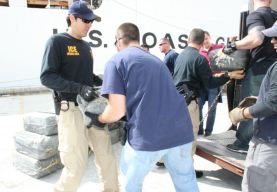
MIAMI - Special agents from U.S. Immigration and Customs Enforcement's (ICE) Homeland Security Investigations (HSI) took custody of three suspected maritime drug smugglers in Miami on Wednesday and helped U.S. Coast Guard crewmembers offload 62 bales of cocaine weighing 3,400 pounds and worth an estimated wholesale value of $48 million.

 On Dec. 17, the crew of the U.S. Coast Guard Cutter Thetis intercepted a go-fast boat 160 nautical miles off the coast of Colon, Panama. The cutter Thetis launched a small boat crew and was assisted by aircraft from the Coast Guard and U.S. Customs and Border Protection (CBP), Air and Marine Branch, to stop the go-fast vessel.

The bales were found and retrieved aboard the smuggling boat by Coast Guard boarding team members.

Assisted by ICE, crewmembers of the Key West-based Cutter Thetis offloaded the 62 bales of cocaine at the Coast Guard base in Miami Beach.

"We are ready to stop all contraband on the high seas with our partners, not only in the U.S., but those international agencies that work with us day to day," said Thetis commanding officer Cmdr. Douglas Schofield, U.S. Coast Guard.

"We are seeing more and more of these kinds of smuggling attempts, as organizations react to increased pressure on the southwest border," said Anthony V. Mangione, special agent in charge of ICE HSI in Miami. "And we will continue to work with our law enforcement partners to put more and more pressure on the organizations that attempt to carry out these and other types of drug smuggling activities."

ICE HSI's investigation into the three suspected smugglers is being conducted by the Miami Border Enforcement Security Task Force (BEST). BEST was established in Miami in November 2008 and at other major seaports because U.S. ports and maritime borders are subject to significant threats to national security.

The mission of the BEST program is to identify, disrupt, and dismantle organizations that seek to exploit vulnerabilities in the U.S. border through increased information sharing and collaboration among partner agencies. The Miami BEST incorporates personnel from ICE HSI; CBP Office of Border Patrol; the Drug Enforcement Administration (DEA); the U.S. Coast Guard; and the Miami-Dade Police Department.

Thursday, June 28, 2007

Law Enforcement Technology

NLECTC Law Enforcement & Corrections Technology News Summary
Thursday, June 28, 2007

"Fingerprint Analyst Helps Solve Crime Mysteries"
Miami Herald (06/25/07); Tablac, Angela

Fingerprint analysis in the
Miami-Dade police department runs continuously on a 24/7 schedule, staffed by 32 analysts who process a minimum of 80 fingerprints a day. Analysis entails comparison of collected prints to databases to identify dead bodies, criminals, and prisoners. Each set of fingerprints goes through multiple levels of verification; matches in a database are manually verified by at least two analysts who look for several similar characteristics between the collected print and the database entry. In addition, analysts are often called to provide testimony in criminal trials where fingerprint evidence is relevant. Fingerprint analysis is often an attractive career to those who have some background in criminal justice but who opt not to become police officers; initial training takes eight weeks, and analysts take supplementary training sessions annually. In addition, they can obtain additional fingerprint classification certification from the FBI. http://www.miamiherald.com/154/story/148703.html

"Computers in Cruisers Give More Data Faster"
Star-Ledger (NJ) (06/22/07) P. 25; Walsh, Diane C.

Middlesex County, N.J., officials have revealed that from patrol car mobile computers, officers between New Brunswick, Woodbridge, Highland Park, and Plainsboro will be able to communicate with each other. In 2005, a program was launched that bridged databases between the prosecutors, sheriffs, and county jails to promote advanced communications among agencies. "It's an example of taking advantage of new
technology to fight crime," said Freeholder Christopher Rafano, overseer of the county law enforcement agencies. Through AT&T, the system was implemented at $358,726; each additional town under the system costs $40,000. Law enforcement officials say the system has allowed for instantaneous information and that the program's expansion among counties will serve as a powerful tool for combating crime.
http://www.nj.com/news/ledger/union/index.ssf?/
base/news-2/1182486863153150.xml&coll=1

"
DNA Advances Led to Rape Suspect"
Journal-World (Lawrence, Kan.) (06/22/07); Reid, Janet

Strides in
technology led to the review of cold cases from the 1990s that allowed investigators to trail and charge a serial rapist more than 10 years after the crime was committed. In 1995, the DNA sample needed for analysis in rape cases had to be at least the size of a quarter; now, only a sample the size of a pinhead is needed. When a rape victim from a 1995 incident called police, investigators retested DNA evidence from her case along with a 1993 and 1994 incident. Using the FBI's Combined DNA Index System (CODIS), police found a match between the DNA of a man who had been entered into the system on petty theft charges and the DNA from all three cases. Lawrence police Sgt. Dan Ward said, "These cases are horrendous, and the three young women have dealt with a lot ... [N]ow they're going to see justice."
http://www2.ljworld.com/news/2007/jun/22/dna_advances_led_rape_suspect/

"Cameras May Go Up Soon"
Milwaukee Journal Sentinel (06/24/07) P. B6; Sandler, Larry

Despite opposition from Milwaukee's Common Council, Mayor Tom Barrett has moved to implement a $1 million-plus program that would install cameras in high-crime areas in the city. The cameras would be monitored via fiber-optic connections and five mobile cameras would be shared among
police departments. Barrett had the support of locals and the council's Public Safety Committee until over $500,000 was sought from the council's Finance & Personnel Committee. Council representatives claimed the funds should have been included in the mayor's budget, while Barrett said that aldermen should have no trouble footing the costs for the technology if they advocated the cameras' installation. Council President Willie Hines Jr. said Barrett should have anticipated costs accordingly, yet he and the mayor have reached an agreement whereby the contingency fund will not be tapped into and the project will be funded by public works and police accounts with an additional $404,000 from government assistance. http://www.jsonline.com/story/index.aspx?id=623825

"Waynesville P.D. Goes High Tech"
The Mountaineer (NC) (06/20/07); Pleming, Beth

The Waynesville, N.C., Police Department has experienced several technological upgrades recently, including access to the new program RAMBLER. When an accident takes place, warrants are dispensed, or a person is arrested, the report is electronically filed and made accessible to each
law enforcement group connected to that software. Another improvement is new in-vehicle computers that permit police personnel to fill out incident and arrest reports in their cars, which means additional time spent on the road performing law enforcement and less time in the office entering information into a computer. Meanwhile, new laptops enable officers to perform a check for other data such as criminal backgrounds, car and license information, and outstanding active warrant notification. Golden Eagle radar devices allow offers to determine the speed of cars that are moving in any direction, including vehicles driving in front of patrol cars and coming from behind. The stealth stat is a radar system that is erected on the side of a road linked to a statistic recording machine that gets the speed and identity of passing cars. Waynesville Police are also using video analysis systems, specifically dTective by Ocean Systems, to study video surveillance recordings in order to identify and arrest thieves.
http://themountaineer.com/cms/display/Top_Stories/pageDisplay.
php?page2display=1182319200*0618%20WPD%20goes%20high%20tech.inc

"Flexible and Fearless, Seeking Rescue Work"
New York Times (06/25/07) P. A12; Blumenthal, Ralph

Texas A&M University's Texas Engineering Extension Service operates a 52-acre "Disaster City" where fire fighters and other emergency responders from across the globe can participate in
training exercises. The site was recently the scene of a robotics exercise sponsored by the Department of Homeland Security's Science and Technology Directorate and the Commerce Department's National Institute of Standards and Technology. Several varieties of rescue robots participated in the exercise, which included obstacle courses based on mock set-ups of the Oklahoma City bombing, 1993 World Trade Center bombing, and Mexico City earthquake. The robots included a 30-foot, snake-like optic robot that slinks through crevasses and holes while providing images of its discoveries. That robot, produced by university researchers in Japan, is attached to the operator's body, unlike most robots, which are operated via consoles or laptops. One Texas A&M official predicted that robots will soon become a regular part of rescue work.
http://www.nytimes.com/2007/06/25/washington/25robots.html?_r=1&
adxnnl=1&oref=slogin&adxnnlx=1182777048-K9v0+v7okjZ5hJp6ZJ8Ghw


"
Law Enforcement Gets an Upgrade"
Spokesman Review (06/20/07) P. B1; Lawrence-Turner, Jody

Police in Spokane, Wash., have received several new technologically-advanced devices recently, including durable laptop computers, which replace mobile data computers formerly found in police patrol vehicles. The laptops, which cost around $5,500 apiece, are updated every day with information concerning suspects. Dashboard cameras are placed on the inside of a police car and record the actions of an officer, and cost around $7,800 each, while Global Positioning Systems, which cost between $450 and $475 for each patrol car, enable police dispatchers to know where patrol units are all the time by examining a computer screen. Meanwhile, electronic ticketing (e-tickets) permit traffic officers to employ a scanner to acquire data from the bar code on the rear side of a driver's license and enable an officer at the scene of an accident to create diagrams of the event utilizing a software program. The e-ticketing printers cost $425 each while the bar-code scanners cost $390 each. Officials note that over three-fourths of the financing for the equipment is provided by grants. On July 18, Spokane police stated they will pursue over $4 million in federal grants for both the city and county that is set aside for technological upgrades and purchases.
http://www.spokesmanreview.com/local/story.asp?ID=195682

"Jersey City 'Court TV'"
Jersey Journal (06/20/07); Pearson, Bernette

The Jersey City Municipal Court introduced on June 19 videoconferencing, which will allow inmates throughout New Jersey to argue their cases from prison while the judge, prosecutor, and public defender remain at the court. Chief Judge Wanda Molina notes that videoconferencing assists in reducing security threats, health risks, and travel expenses. Officers typically assigned to moving inmates can now be assigned to other prisoners in New Jersey facilities that can have their cases heard faster, she adds. The technology is already used at
New Jersey Superior Court in Jersey City and at another five municipal courts in Hudson County. Molina states that municipal courts handle around 20 misdemeanor cases each day, including assault and drug cases. The cameras function through T-1 lines, similar to a video phone call but on a bigger scale. An inmate will sit in a wired room in the prison and view the court proceedings on a TV screen with a police officer close by. The individual charged presents a plea and then a trial date is scheduled or other arrangements are set.
http://www.nj.com/news/jjournal/index.ssf?/
base/news-4/1182319381146570.xml&coll=3

"'Stepping Out' Suspended After Death of Howard Officer"
Baltimore Sun (06/26/07)

The death of a Howard County police officer during a traffic enforcement operation on Route 32, near I-95, caused the Howard County
police department and the nearby Anne Arundel County police department to suspend their "stepping out" policies. A team of two officers is used on occasion to stop speeders on highways and other roads; one officer mans the radar equipment, while the other steps into traffic to flag down speeders. Howard County officers will no longer step into traffic on roads with speed limits above 35 mph, and Anne Arundel County officers will not step out into traffic to catch speeders at all. Both departments plan to extensively review the policy and determine how it can be improved to prevent needless officers' deaths and still enforce traffic laws effectively.
http://www.baltimoresun.com/news/local/bal-md.
digest26jun26,1,7581568.story?ctrack=2&cset=true

"Cities Using Cameras Admit Tapes as Court Evidence"
Oklahoman (06/21/07) P. 14A; Bisbee, Julie

About 40
police cars in Ardmore, Okla., will be equipped with dashboard-mounted cameras. The police department there hopes the cameras will help officers record suspect behavior, and help protect officers from any false allegations of misconduct. Many cities that have already instituted this technology are allowing the video and audio from patrol cars to be admitted as trial evidence. This policy prevents defendants from denying or reinterpreting their actions in front of a judge or jury. http://newsok.com/article/3068821

"Police Lift Hold on Buying Tasers"
Lexington Herald-Leader (KY) (06/19/07) P. B1; Ku, Michelle

City council members in Lexington, Ky., have recently approved the purchase of 50 Tasers for the 50 new
police officers the city will be taking on in the next year. The Lexington police department had previously instituted a ban on the use of Tasers because of reports that the weapons were responsible for upwards of 200 deaths in the United States. The department has lifted the ban after reviewing several studies which concluded stun guns alone were not responsible for fatalities. When used properly, Tasers offer police a safer option to subdue suspects. All Lexington officers receive extensive training on the use of these weapons in order to avoid abuse. http://www.kentucky.com/211/story/101705.html

"Unmanned Aircraft Assist for U.S. Hunt in Explosives"
Wall Street Journal (06/17/07); Pasztor, Andy

American
military forces and their Iraqi allies are employing more sophisticated technologies, including tiny unmanned aircraft constructed by Honeywell International Inc. to attempt to locate deadly explosive gadgets concealed on the battlefront. Honeywell has implemented infrared cameras and additional sensors on small, remotely-operated helicopter-type devices, known as Micro Air Vehicles (MAVs), that can sit right above suspect sites and transmit images back to soldiers employing a portable handheld terminal. Thought to be the initial unmanned aerial vehicle of its kind specifically used in Iraq to uncover hidden explosives, the MAV weighs around 14 pounds, lifts off vertically, and can function at altitudes from just a fewer inches off the ground to over 10,000 feet. Barely one foot in diameter, the MAVs can fly at over 50 miles an hour. They are part of the firm's effort to create new surveillance technologies to increase its military, space, and homeland security operations. The introduction is part of a wider trend to create more innovative equipment to locate and take apart Improvised Explosive Devices, responsible for the bulk of American deaths in the combat in Iraq. The action occurs as British forces are moving toward utilizing high-tech radars created by a Raytheon division to look for these devices from much greater altitudes. http://online.wsj.com/article_print/SB118212024940938400.html

"Interoperability Academy Takes the Static Out of Emergency Communications"
County News (06/04/07) Vol. 39, No. 11, P. 3; Lopes, Rocky

At the May NACo/National League of Cities Interoperability Policy Academy conference, local government officials discussed how they could improve the interoperability of communications through governance, standard operating procedures,
technology, training, and exercises. As part of the suggested improvements to governance, officials highlighted the need for greater cooperation among regional officials as well as an avenue through which first responders could offer feedback about the system. Experts also suggested the establishment of standard operating procedures to ensure all personnel, despite where they are located, can successfully use communications equipment and designated channels. However, National Institutes of Standards and Technology Program Manager Dereck Orr noted, "Soon, data may be more important than voice, so having equipment that can share data across platforms is critical," a notion that fed into the call for technology upgrades. One major obstacle for these counties and local government officials is where to garner the funding for upgrades, especially if they are not part of the Urban Area Security Initiative (UASI). Grant writers and experts were on hand to help officials apply for money to cover the costs of interoperability upgrades and training, but most indicated that multi-agency plans or multi-jurisdictional plans were the likeliest candidates for grant allocation. Other officials cited the plans underway in their regions, including Minnesota, which has hospitals, police, and fire departments coordinating their emergency response plans to ensure success and continuous training for workers.
http://www.naco.org/CountyNewsTemplate.cfm?template=/
ContentManagement/ContentDisplay.cfm&ContentID=23792

"Evacuation Software Finds Best Way to Route Millions of Vehicles"
University of Arizona (06/11/07); Stiles, Ed

University of Arizona assistant professor of civil engineering Yi-Chang Chiu has been developing Multi-Resolution Assignment and Loading of Traffic Activities (MALTA), software designed to simulate large-scale evacuations during a disaster to help transportation officials determine the best traffic management strategy. "Solving large-scale evacuation problems is overwhelming," Chiu says. "No one can just sit down with a map and draw lines and figure out the best answer to problems like these." Chiu says MALTA reacts to a situation in real time, adjusting as the scenario changes. The software relies on detailed traffic census data collected by state and city transportation departments, as well as real-time traffic surveillance data. The software predicts actions drivers may take, such as when they leave and what road they take, and adjusts for factors that may alter drivers' plans, such as radio reports, congestion, and freeway message boards. The program is also able to predict airborne hazards, such as toxic gas from a refinery fire. By using air-plume dispersion models and wind direction, speed, and temperature, the program can calculate health risks and potential casualties. The program also provides post-disaster assistance by helping officials make choices such as which highway to repair and open first. Chiu says MALTA will be ready soon for state transportation and emergency medical agencies. The next generation of MALTA uses parallel processing and is designed to run faster, handle larger networks, and respond minute-by-minute to real-time emergencies.
http://uanews.org/cgi-bin/WebObjects/UANews.woa/
35/wa/MainStoryDetails?ArticleID=13956

"City Spends Millions on Cop Car Crashes"
Northwest Indiana News (06/06/07); Luntz, Taryn

The
Tulsa Police Department reports a disproportionate number of police accidents that occur during law enforcement pursuits. The National Highway Traffic Safety Administration (NHTSA) reports although police pursuits take the life of one person a day, police departments are not required to track these incidences. "A department that's not tracking pursuits is asking for trouble," and officials note incidences involving firearms are not neglected like police pursuit accidents. In 2006, Chicago spent $7 million on settling lawsuits involving police pursuits, and usually, lawsuits become classified as "motor vehicle accidents" when pedestrians are hit or accidents occur at intersections. Experts note that police departments taking the time to investigate average pursuit speeds, numbers of injuries, and numbers of deaths related to police pursuits are better equipped to institute policies to reduce those numbers through officer training programs focusing on driving skills.; the Chicago Police Department's vehicle pursuit policy does not refer to any driver training programs for officers.
http://nwitimes.com/articles/2007/06/06/news/
illiana/doc7ef0e3f776a0c0e9862572f2000ab951.txt

Saturday, March 10, 2007

Virtual Justice and other works

Police-Writers.com, a website dedicated to listing state and local police officers who have authored books added three police officers who have written books.

Richard Calvert’s thirty-five years of big city police work has given him up-front and hands on experience with all segments of criminal activity. As a lieutenant on the Miami-Dade Police Department, he was involved in the investigation of hundreds of crimes, complicated by the ethnic diversity of Miami; and, taking him to all corners of the United States and Puerto Rico. Richard Calvert was motivated by his disenchantment with the criminal justice system and his compassion for the victims of homicide, armed robbery, narcotics, organized crime and sexual battery, he felt compelled to write his novel – Virtual Justice. Educated at Virginia Tech and Florida International University, he holds a B.S. degree in criminology.

According to one reader of Virtual Justice, “A fine work that gives the reader a classic look at scenarios facing the big city detective. Police work, politics, and the justice system combine to make "Virtual Justice" an exciting, informative thriller. Though a work of fiction the players in this book could very well be real. I was continuously looking forward to reading the next chapter.”

Dale C. Carson was a Deputy Sheriff from 1974 to 1976 with the Dade County Public Safety Department (which later became known as the Miami-Dade Police Department) he has been an FBI agent, private investigator and criminal defense attorney. Currently, as of March 2007, Dale C. Carson, is running for Sheriff of Duval County (Florida). Dale Carson’s book is Arrest Proof Yourself. According to the book description, “This essential “how not to” guide explains how to act and what to say in the presence of police to minimize the chances of being arrested and to avoid add-on charges—which can often lead to permanent disqualification from jobs, financing, and education. Citizens can learn how to avoid arrest both on the street and when pulled over in a vehicle and are alerted to basic tricks cops use to get people to incriminate themselves. Sprinkled with absurdity and humor, this urgent, eye-opening book is a guide to criminal justice for all Americans.”

A 30 year veteran of law enforcement,
Alex J. McDonald, is a deputy sheriff with the Broward County Sheriff’s Office (Florida). He has published extensively in law enforcement periodicals, as well as magazines about karate and skin diving. According to the book description of his first novel, Sawgrass, “A missing cop is found dead in his car in an orange grove. Suicide or murder? The evidence points to murder but the bureaucrats want it to be suicide. Det. Sgt. Daniel Quinn is in charge of the investigation and sets out to prove murder. A second murder occurs and Quinn finds the two are connected. Quinn becomes embroiled in a drug smuggling investigation and is forced to battle politics, a smuggling group and even the D.E.A. All of this leads to a surprise ending.”

Police-Writers.com now hosts 386
police officers (representing 161 police departments) and their 836 books in six categories, there are also listings of United States federal law enforcement employees turned authors, international police officers who have written books and civilian police personnel who have written books.