Showing posts with label mexican government. Show all posts

Wednesday, June 06, 2012

DEA HONORED BY MEXICO PRESIDENT CALDERON


DEA Administrator Michele M. Leonhart became one of the first foreign officials in history to receive Mexico’s Merit of Honor from President Felipe Calderon for her leadership and commitment in supporting the Mexican Federal Police (SSP) in combating organized crime.  The ceremony took place in Iztapalapa, Mexico on June 2nd.

SSP holds this event every year to recognize Federal Police sacrifices and achievements as well as new capabilities of this rapidly transforming institution.  President Calderón and the First Lady were in attendance, as well as cabinet members, military leaders, state governors, the diplomatic community, media, and key representatives from the private sector. 

In addition, President Calderón also presented awards to Colombian National Police Chief General Oscar Naranjo, INTERPOL Secretary General Ronald Noble, and Former Commissioner General of Information, Spanish National Police Jesus de la Morena for their commitment to battling organized crime worldwide.

“This is a tremendous honor for DEA and represents our unwavering support and commitment to Mexico in battling the world’s most ruthless criminal networks,” Administrator Leonhart said. “Together we have shown that the rule of law can prevail on both sides of the border and we look forward to continued joint success in the fight against transnational crime.”

Monday, April 02, 2012

AFO Leader Gets 25 Years in Prison


San Diego, CA – DEA Administrator Michele M. Leonhart today announced that Benjamin Arellano-Felix, nearly 60, the former leader of the Tijuana Cartel/Arellano-Felix Organization (AFO) was sentenced today in U.S. District Court in San Diego by the Honorable Larry A. Burns to serve 25 years in federal prison. Judge Burns also ordered Arellano-Felix to forfeit $100 million in criminal proceeds. The sentence followed Arellano-Felix’s conviction for racketeering and money laundering.

 “The Tijuana Cartel was one of the world’s most brutal drug trafficking networks, but has now met its demise with leader Benjamin Arellano-Felix’s sentencing today,” said DEA Administrator Michele M. Leonhart. “It is a major victory for DEA and Mexico’s Calderon Administration. Together, we will continue our pressure on the Mexican Cartels whose leaders, members and facilitators will be prosecuted and face the justice they fear.”

“Today’s prison sentence virtually ensures that Arellano-Felix will spend the remainder of his life in custody. Following this sentence, he will be deported to Mexico to finish a 22-year sentence. This is a fitting end for a person who has caused so much suffering and destruction,” commented United States Attorney Duffy. Duffy heralded the sentence as a landmark achievement in the United States and Mexico’s joint effort to dismantle drug cartels operating on both sides of the border and stated that “Attorney General Eric Holder and Mexican Attorney General Marisela Morales are pleased with today’s result and that this defendant has finally been held accountable for his crimes. Today’s sentence, together with what remains of his sentence in Mexico, will go a long way in ensuring that Arellano Felix spends his remaining years in prison.”

Long-reputed to be one of the most notorious multi-national drug trafficking organizations to ever exist, the AFO controlled the flow of cocaine, marijuana and other drugs through the Mexican border cities of Tijuana and Mexicali into the United States. Its operations also extended into southern Mexico and Colombia. Arellano-Felix was taken into custody by Mexican authorities on March 9, 2002. A final order of extradition to the United States was granted in 2007 and after years of unsuccessful appeals, Arellano-Felix arrived in the U.S. on April 29, 2011, to face charges in the Southern District of California for narcotics trafficking, money laundering and organized crime-related offenses. On January 4, 2012, he entered his guilty pleas before Judge Burns.

San Diego FBI Acting Special Agent in Charge Eric Birnbaum commented, “Today's sentencing marks the end of Mr. Arellano-Felix's reign as the leader of one of the most dangerous drug and organized crime organizations our agencies have ever investigated. While there is still much work to do, it is particularly noteworthy that this culmination would not have been possible without the cumulative efforts of law enforcement on both sides of the border. We are pleased to stand united against the violence brought forth by the AFO and see this individual brought to justice.”

“The money laundering investigation conducted by IRS Special Agents contributed to the dismantling of one of the most notorious and violent drug cartels in Mexico,” commented Leslie P. DeMarco, Special Agent in Charge of IRS Criminal Investigation Los Angeles Field Office. “Today’s sentencing is further evidence of the successful partnership that IRS Criminal Investigation has with other law enforcement agencies by using our financial expertise to unravel the money laundering component of this multi-national drug-trafficking organization.”

According to court records and the defendant’s admissions, Arellano-Felix was the leader of the AFO from approximately 1986 to until his arrest on March 9, 2002. During that time,
Arellano-Felix served as the ultimate decision-maker for the AFO. Arellano-Felix issued directives to other members of the AFO, including his brothers, Ramon, Eduardo, and Francisco Javier Arellano-Felix, as well as his top lieutenants and drug-trafficking partners.

Arellano-Felix and other AFO members conspired to import and distribute within the United
States hundreds of tons of cocaine and marijuana, for which the AFO obtained hundreds of millions in U.S. dollars in profits. At Arellano-Felix’s direction, members of the AFO kidnaped, physically restrained and murdered numerous persons in furtherance of the AFO's illegal activities. Also at Arellano-Felix’s direction, members of the AFO bribed law enforcement and military personnel, and murdered informants and potential witnesses in order to obstruct or impede the official investigation of their activities. Arellano-Felix conspired with other members of the AFO to launder proceeds of the above drug trafficking activities by directing other members to transport, transmit, and transfer hundreds of millions in U.S. dollars from the United States to Mexico.

This case was investigated by agents from the Drug Enforcement Administration, the Federal
Bureau of Investigation, and the Internal Revenue Service-Criminal Investigation and prosecuted in the Southern District of California by Assistant United States Attorneys Joseph Green, James
Melendres, and Daniel Zipp. The Criminal Division’s Office of International Affairs provided significant assistance in the extradition. The investigation was coordinated by an Organized Crime Drug Enforcement Task Force (OCDETF). The OCDETF program was created to consolidate and coordinate all law enforcement resources in this country's battle against major drug trafficking rings, drug kingpins, and money launderers.

Friday, March 16, 2012

Member of Gulf Cartel Re-Arrested


BROWNSVILLE, TX—Juan Carlos De La Cruz Reyna, 37, has been arrested on charges of bribery, United States Attorney Kenneth Magidson announced today. De La Cruz had been convicted of two counts of threatening to assault and murder federal agents in 2009 and sentenced to 30 months in federal prison. Set to be released on the previous charges this month, he and six others are accused of bribing a federal officer in attempt to secure safe passage back to his home country of Mexico.

According to the criminal complaint, in or about May 2011, Julio Torres, 39, of Brownsville, Texas, began negotiations with an Immigration and Customs Enforcement-Homeland Security Investigations (ICE-HSI) undercover agent regarding making bribery payments to facilitate a transfer of De La Cruz to a Texas facility as well as his release to elements of the Gulf Cartel instead of Mexican authorities. Torres and De La Cruz believed the Mexican government had additional criminal charges against De La Cruz and Torres allegedly stated he and others would pay additional money to ensure De La Cruz would not be turned over to Mexican authorities upon his removal to Mexico. Torres also claimed De La Cruz and his associates were fearful that if De La Cruz were to be deported to another Mexican location, apart from Ports of Entry in Tamaulipas, rival drug cartels may abduct him, according to allegations in the criminal complaint.

The agent received an initial payment of $4,000 from Torres to begin the process of transferring De La Cruz to Texas. De La Cruz placed a phone call to the agent to discuss his transfer and confirm the payment at which time De La Cruz then gave permission to continue making arrangements for his transfer. On June 28, 2011, the agent met with Torres, who introduced Mexican National Adalberto Nunez-Venegas, 39, as the person sent by De La Cruz to oversee all future negotiations and payments. Over the next several months and leading up to the filing of the criminal complaint, Torres and Nunez made an additional eight cash payments totaling $542,090. In addition, six real estate properties had been signed over to the agent to provide collateral for the final payment of $460,000.

De La Cruz had also allegedly told the agent that he wanted to see a copy of his immigration detainer as further proof he would be transferred back to Texas prior to removal to Mexico. In September 2011, another ICE-HSI special agent, acting in an undercover capacity, provided De La Cruz a copy of his immigration detainer, and in January 2012, the same agent met with him to go over the final plans for the transfer to Texas.

In February 2012, Torres allegedly introduced Carlos Melo, 38, of Brownsville, Texas, as an associate involved in these negotiations and assisting Torres. According to the complaint, Melo assured the agent he was aware of the bribery scheme, that the agent was a law enforcement officer, and that Melo was assisting the rest of the conspirators to help De La Cruz. During a discussion of the future release of De La Cruz, Torres allegedly told the agent Melo would be a driver during the release of De La Cruz to which Melo allegedly agreed.

De La Cruz was transported via plane to a Texas federal facility on March 9, 2012. This past weekend, the agent met with De La Cruz, Nunez, and Torres to discuss his release into Mexico, at which time the agent stated De La Cruz would not be released to elements of the Gulf Cartel if the agent and his associates did not receive their final payment of $460,000.

On March 13, 2012, Gaspar Martinez Montes, 41, a legal permanent resident residing in Harlingen, Texas, allegedly imported into the United States $134,003 in U.S. currency and declared the currency was to be used to purchase items for personal business. On the same date, Martinez, along with Nunez-Venegas and Juan Trejo-Venegas, 33, of Matamoros, Mexico, met with the undercover agent and delivered $250,010 as a payment to help ensure the safe passage of De La Cruz into Mexico, at which time the agent told Nunez, Martinez, and Trejo-Venegas to be prepared to assist in the upcoming release of De La Cruz.

Yesterday, Torres, Melo, Nunez-Venegas, Martinez, Trejo-Venegas, and Jose C. Venegas, 36, of Brownsville, met with the agent to discuss a logistical plan that would ensure that De La Cruz would be deported as had been agreed in previous negotiations. As part of the plan, according to the complaint, Torres and Nunez told the agent that Torres and Melo had agreed to ride together in one vehicle and Nunez and Venegas would drive in another vehicle while acting as escorts for De La Cruz. Martinez, Trejo-Venegas and Venegas were also present during the discussion.

All the men were taken in custody last night. De La Cruz, Torres, Melo, and Nunez-Venegas are set to appear before U.S. Magistrate Judge Ronald Morgan for a detention hearing on March 20, at 1:30 p.m., while Martinez, Trejo-Venegas, and Venegas are scheduled to have an initial appearance before Magistrate Judge Morgan tomorrow at 10:00 a.m.

The case was investigated by ICE-HSI, FBI, and the Brownsville Police Department and is being prosecuted by Assistant United States Attorney Jody Young and Angel Castro.

A criminal complaint is a formal accusation of criminal conduct, not evidence.

A defendant is presumed innocent unless convicted through due process of law.

Wednesday, December 21, 2011

Defendant charged with alleged participation in the murder and attempted murder of 2 ICE special agents is extradited from Mexico to the United States

WASHINGTON — Julian Zapata Espinoza, also known as "Piolin," has been extradited from Mexico to the United States to face charges for his alleged participation in the murder of U.S. Immigration and Customs Enforcement (ICE) Special Agent Jaime Zapata and the attempted murder of ICE Special Agent Victor Avila on Feb. 15, 2011, in Mexico.

The charges and extradition were announced today by ICE Director John Morton; Assistant Attorney General Lanny A. Breuer, Justice Department's Criminal Division; U.S. Attorney Ronald C. Machen Jr., District of Columbia; and FBI Assistant Director Kevin Perkins, Criminal Investigative Division.

"The extradition and charges filed against Zapata Espinoza is an important step in bringing Jaime and Victor's alleged shooters to justice," said ICE Director Morton. "All of us at ICE are encouraged by today's action and appreciate the unwavering work and support of all our law enforcement partners in this case. Our hearts and prayers continue to go out to Jaime's family and his close colleagues within the ICE community. ICE will continue to see that Jaime and Victor's work is done by continuing our efforts with all involved in working on this case."

On April 19, 2011, a federal grand jury in the District of Columbia returned a four-count indictment against Zapata Espinoza, charging him with one count of murder of an officer or employee of the United States, for the murder of ICE Special Agent Zapata; one count of attempted murder of an officer or employee of the United States and one count of attempted murder of an internationally protected person, both for the attempted murder of ICE Special Agent Avila; and one count of using, carrying, brandishing and discharging a firearm during and in relation to a crime of violence causing death.

"Julian Zapata Espinoza ("Piolin") allegedly participated in the murder of ICE Special Agent Jaime Zapata and the attempted murder of ICE Special Agent Victor Avila," said Assistant Attorney General Breuer. "The indictment unsealed today, and the successful extradition of Piolin to the United States, reflect the Justice Department's vigorous and determined efforts to seek justice for Agents Zapata and Avila. We will continue to work closely with our law enforcement partners in Mexico to hold violent criminals accountable."

"This prosecution exemplifies our unwavering effort to prosecute those who committed this heinous offense against U.S. law enforcement agents," said U.S. Attorney Machen. "We will not rest until those responsible for the murder of Agent Zapata and the wounding of Agent Avila are brought to justice."

"The extradition of Julian Zapata Espinoza to face charges in the U.S. is a significant development in the ongoing investigation into the murder of Special Agent Jaime Zapata and attack on Special Agent Victor Avila," said FBI Assistant Director Perkins. "This extradition would not have been possible without the dedicated efforts of all involved in this case. The FBI, DHS and the Department of Justice will continue its pursuit of justice for the Zapata family."

The indictment was unsealed today, when Zapata Espinoza made his initial appearance before U.S. District Chief Judge Royce Lamberth of the District of Columbia. Zapata Espinoza was ordered detained without bail. His next appearance in court is scheduled for Jan. 25, 2012.

The case is being investigated by the FBI, with substantial assistance from ICE; the Bureau of Alcohol, Tobacco, Firearms and Explosives; the Drug Enforcement Administration; U.S. Customs and Border Protection; U.S Department of State, Bureau of Diplomatic Security; and the U.S. Marshals Service. The investigation was also coordinated with the assistance of the Government of Mexico.

The case is being prosecuted by the Organized Crime and Gang Section and the Narcotic and Dangerous Drugs Section of the Justice Department's Criminal Division and the U.S. Attorney's Office for the District of Columbia. The Office of International Affairs of the Justice Department's Criminal Division provided substantial assistance.

An indictment is a formal charging document and defendants are presumed innocent until proven guilty.

Tuesday, November 29, 2011

Nogales Agents Discover Second Illicit Tunnel

Tucson, Ariz. –The Tucson Sector Border Patrol, a component of the Joint Field Command-Arizona, discovered another illicit tunnel yesterday in Nogales, just six days after their earlier find of a smaller tunnel in the same town.

The latest tunnel is 319 feet long and extends 219 feet into the United States and 100 feet into Mexico. It is approximately 20 feet below the surface and measures three feet wide by two feet tall. This tunnel is more sophisticated than other recently discovered tunnels. It appears to have been chiseled through solid rock and was equipped with various digging tools, saws, electricity, lighting, water pumps, plywood shoring and 4x4 support beams. (Photos available)

While securing the tunnel, Nogales Border Patrol agents also found 26 bundles of marijuana weighing more than 430 pounds and worth approximately $215,000. The narcotics were turned over to the Drug Enforcement Administration.

U.S. Immigration and Customs Enforcement’s Homeland Security Investigations is the lead investigative agency. U.S. Customs and Border Protection will handle the tunnel remediation.

By increasing the likelihood of being detected by Border Patrol agents and the penalties associated with illicit activity, transnational criminal organizations have become desperate as demonstrated by their continued attempts to move their operations underground.

The Tucson Sector works closely with strategic partners such as ICE HSI, DEA, and Mexican authorities to monitor activity associated with existing and new tunnel infrastructure, making it increasingly difficult for smugglers to operate with impunity and transport their contraband throughout the United States.

Customs and Border Protection appreciates assistance from the community. Citizens can report suspicious activity by calling the Border Patrol at (1-877) 872-7435 and remain anonymous.

U.S. Customs and Border Protection is the unified border agency within the Department of Homeland Security charged with the management, control and protection of our nation's borders at and between the official ports of entry. CBP is charged with keeping terrorists and terrorist weapons out of the country while enforcing hundreds of U.S. laws.

Monday, August 22, 2011

High-Ranking Member of Mexican Gulf Cartel Extradited to the United States to Face Drug Conspiracy Charges

WASHINGTON – Aurelio Cano-Flores, aka “Yankee” and “Yeyo,” a high-ranking member of the Mexican Gulf Cartel, has been extradited to the United States from Mexico to face drug conspiracy charges, announced Assistant Attorney General Lanny A. Breuer of the Justice Department’s Criminal Division and Administrator Michele M. Leonhart of the Drug Enforcement Administration (DEA).

Cano-Flores, 39, made his initial appearance today before U.S. Magistrate Judge John M. Facciola in the District of Columbia, after being extradited to the United States on Aug. 19, 2011.   Cano-Flores was ordered detained in federal custody pending trial.   Cano-Flores had been in the custody of Mexican authorities pending extradition since his arrest on June 10, 2009.

Cano-Flores was charged, along with 19 other defendants, in a superseding indictment returned on Nov. 4, 2010.   He is charged with conspiracy to manufacture and distribute five kilograms or more of cocaine and 1,000 kilograms or more of marijuana for importation into the United States.

 “As charged in the indictment, Cano-Flores led the Gulf Cartel’s drug trafficking activities in Camargo, Mexico,” said Assistant Attorney General Breuer.   “Cano-Flores was allegedly responsible for ensuring that multi-ton quantities of cocaine, heroin and marijuana were shipped into the United States, and that the illegal drug proceeds were subsequently funneled back into Mexico.   Together with our counterparts across the border, the Justice Department is committed to bringing cartel leaders and associates to justice for their crimes, and the violence and destruction they cause.”

“Today we have brought to a court of law Aurelio Cano-Flores, a major drug trafficker connected to the extreme violence of the Los Zetas and Gulf Cartels and who allegedly is responsible for transporting multi-ton quantities of drugs into the United States,” said DEA Administrator Leonhart. “This is part of a concerted, combined, and coordinated effort by Mexico and the United States to target the command and control of the drug trafficking cartels. This extradition is another example of our enduring commitment to bring to justice violent criminals who deny justice to others, and whose drugs are a threat to both our nations.” 

According to court documents, Cano-Flores was a high-ranking member of the Gulf Cartel when it worked in close partnership with Los Zetas, collectively known as “The Company.”   The Gulf Cartel allegedly transported shipments of cocaine and marijuana by motor vehicles from Mexico to cities in Texas for distribution to other cities within the United States.   The indictment alleges that Cano-Flores, his co-defendants and others organized, directed, and carried out various acts of violence against Mexican law enforcement officers and rival drug traffickers to retaliate against and to intimidate anyone who interfered with, or who were perceived to potentially interfere with, the cocaine and marijuana trafficking activities of the Gulf Cartel.

According to the indictment, from June 2006 until his arrest, Cano-Flores’s role was to oversee drug trafficking activities in Camargo, Nuevo Leon, Mexico, including procuring for distribution significant quantities of cocaine, heroin and bulk marijuana.   Cano-Flores also is alleged to have coordinated the movement of illegal narcotics from Mexico into the United States as well as the repatriation of drug proceeds into Mexico.   The Gulf Cartel controls most of the cocaine and marijuana trafficking through the Matamoros, Mexico, corridor to the United States.   Los Zetas began as the enforcement wing of the Gulf Cartel, but has emerged in recent years as an independent drug trafficking organization.

On April 15, 2009, under the Foreign Narcotics Kingpin Designation Act, the President identified Los Zetas as a Significant Foreign Narcotics Trafficker.   On July 20, 2009, the U.S. Department of the Treasury's Office of Foreign Assets Control (OFAC) also identified the leadership of Los Zetas, Heriberto Lazcano-Lazcano and Miguel Angel Trevino Morales, as Significant Foreign Narcotics Traffickers.    Both men are named as co-defendants in the indictment charging Cano-Flores.   On July 25, 2011, an executive order was issued that blocks the transfer, payment or export of property belonging to certain transnational criminal organizations, including Los Zetas.

The department expressed its gratitude and appreciation to the government of Mexico for its cooperation and assistance in the apprehension and extradition of Cano-Flores.    

An indictment is merely an allegation, and a defendant is presumed innocent unless and until proven guilty beyond a reasonable doubt in a court of law.

If convicted, Cano-Flores faces a mandatory minimum of 10 years in prison and a maximum penalty of life in prison.  

The case is being prosecuted by trial attorneys from the Criminal Division’s Narcotic and Dangerous Drug Section.   The Criminal Division’s Office of International Affairs provided significant assistance in the extradition.   The investigation in this case was led by the DEA’s Houston Field Division and the DEA Bilateral Investigation Unit.

Tuesday, June 28, 2011

U.S. Citizen Arrested Pursuant to an Official Request by the Government of Mexico for Extradition

United States Attorney Laura E. Duffy announced today that United States citizen Cruz Edward Dominguez was arrested on June 23, 2011, pursuant to an official request by the Government of Mexico for his arrest and extradition on charges of aggravated homicide.

According to a complaint filed in U.S. federal court, Dominguez is wanted for killing Joshua Allen Dietrich, a United States Navy seaman, in a nightclub in Tijuana, Baja California, on June 9, 2002. The complaint alleges that during a fight between various patrons of the “Myster E’s” nightclub, Dominguez stabbed Dietrich with a folding pocket knife that Dominguez had brought into the nightclub.

Dominguez' s arrest concludes a nine-year investigation involving substantial diplomatic efforts, complex international issues and extensive legal processes. The Government of Mexico worked closely with the U.S. Department of Justice, the Naval Criminal Investigative Service, U.S. State Department, the Federal Bureau of Investigation and U.S. Marshals Service.

Dominguez appeared today before United States Magistrate Judge Jan M. Adler and was held without bail pending a further hearing on July 19, 2011.

Monday, June 20, 2011

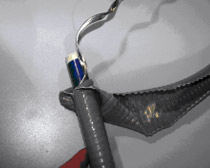
ICE assists Mexican authorities in seizing over $2.4 million concealed inside telephone cable

MEXICO CITY - Mexico's customs authority, the Servicio de Administración Tributaria (SAT), with assistance from the U.S. Immigration and Customs Enforcement's (ICE) Homeland Security Investigations (HSI), seized over $2.4 million concealed within four large rolls of telephone cable at the cargo facility of Mexico City's Benito Juarez International Airport. The money was to be placed on a flight bound for Caracas, Venezuela.

On June 16, 2011, the Mexican authorities seized the currency for federal prosecution by the Procuraduría General de la República (PGR). U.S. and Mexican investigators continue to follow-up on all investigative leads.

The seizure is the result of joint HSI and SAT efforts under Operation Firewall, a comprehensive law enforcement operation targeting criminal organizations involved in the smuggling of large quantities of U.S. currency.

HSI is the largest investigative arm of DHS, charged with enforcing a wide array of laws, including those related to financial crime, trade fraud, narcotics smuggling, cash smuggling, and others. HSI has taken a leading role in combating bulk cash smuggling.

The HSI Office of International Affairs is a critical asset in this mission, responsible for enhancing national security by conducting and coordinating international investigations involving transnational criminal organizations and serving as HSI's liaison to counterparts in local government and law enforcement. With agents in 69 offices in 47 countries, including Mexico City, the HSI Office of International Affairs works with their foreign counterparts to identify and combat transnational criminal organizations before they threaten the United States.

In October, U.S. Department of Homeland Security (DHS) Secretary Janet Napolitano and ICE Director John Morton joined senior Mexican officials to host the first-ever graduation of Mexican customs officials from a 10-week, HSI-led investigator training course at the Federal Law Enforcement Training Academy in North Charleston, S.C. Twenty-four men and women from SAT participated in the inaugural session of the Mexican customs investigator training conducted by HSI agents.

The course included coursework in both Mexican and U.S. customs law, as well as training in a wide variety of investigative techniques, officer safety tactics, and ethics - helping to provide the graduates with the tools and knowledge necessary to combat cross-border crime, including money laundering, customs offenses and weapons and drug trafficking, in close coordination with HSI special agents and other U.S. law enforcement officials.