Showing posts with label marine corps. Show all posts

Monday, September 29, 2025

From Fleet to Courtroom: Program Trains Enlisted Marines to Become Lawyers

Marine Corps 2nd Lt. William Hardwick is one of the initial applicants to be selected for the Enlisted to Judge Advocate Program. Before earning his commission, he served as a sergeant in the Marine Corps, where he worked as a legal services specialist. 
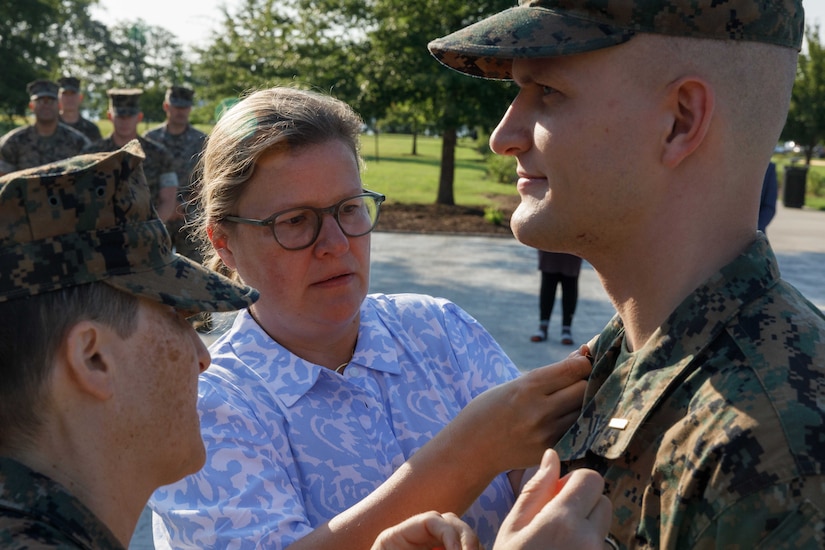
A person in a camouflage military uniform and a person in casual attire pin a military rank on the collar of another person wearing a military uniform outside.

 
The program offers qualified enlisted Marines a fully funded path to becoming a Marine Corps lawyer. Those selected attend Officer Candidates School, then head to an American Bar Association-accredited law school, followed by The Basic School and Naval Justice School, all while receiving active-duty pay and benefits. 
 
"This is a tremendous opportunity," Hardwick said. "If you are enlisted and have any interest in this program, look into it, read the relevant [Marine administrative messages], orders and regulations, reach out to the [points of contact], find a judge advocate and ask them about their job." 
 
Program applicants must hold a bachelor's degree with a GPA of 3.0 or higher, score at least a 150 on the LSAT, have between four and eight years of active service and be in good standing with no disciplinary actions. 
 
The selection board for the fiscal year 25 cycle closed in August, but the program runs annually. 
 
"The big benefit of this program is you continue to be active duty while you are in law school, with no break in service and no break in benefits," Hardwick said. "While you are in school, you will continue to be paid basic pay and basic allowance for [housing], which puts you ahead of your peers in law school. All three years of law school will count towards your retirement, if you choose to have a full 20-year career." 
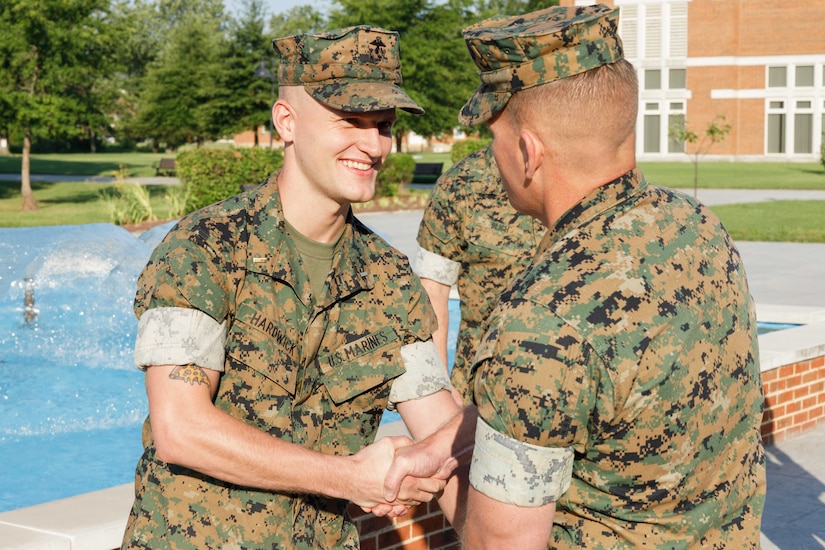
Two people wearing camouflage military uniforms shake hands outside.

 
Prior to entering the program, Hardwick served as the noncommissioned officer in charge of the Defense Services Organization at Camp Lejeune, North Carolina. His supervisor, Marine Corps Maj. Lauren Neal, recognized how quickly he became paramount to the office, noting that Hardwick's experience, both in and out of the courtroom, set him apart as a candidate for the Enlisted to Judge Advocate Program. 
 
"He consistently demonstrated the kind of leadership and judgment we strive to instill in every Marine," Neal said. "He brings operational insight, credibility and a deep commitment to the Marine Corps' core values of honor, courage and commitment." 
 
Hardwick is currently attending Fordham University in New York City, working toward his goal of serving in the Marine Corps as a judge advocate.

Thursday, May 17, 2012

Hopi Man, a Former Marine Sniper, Sentenced to Federal Prison for Shooting Spree


PHOENIX—On May 14, 2012, Mitchell James Karty, 39, of Second Mesa, Arizona, was sentenced by U.S. District Judge James A. Teilborg to 177 months (14.75 years) in federal prison. Karty pleaded guilty on February 21, 2012 to use of a firearm during and in relation to a crime of violence, assault with a dangerous weapon, and assault of a federal officer.

“These officers demonstrated tremendous courage and put their lives on the line to remove a domestic violence victim and her family from serious danger,” said Acting U.S. Attorney Ann Birmingham Scheel. “Just as these officers were committed to protecting the victim, her family, and the community, the U.S. Attorney’s Office is deeply committed to prosecuting violent crime and ensuring public safety in Indian Country.”

According to court documents, on October 5, 2011, police officers responded to a residence on the Hopi Indian Reservation following a domestic violence incident in which Karty was the suspect. Officers waited at the residence while the victim of the incident packed some belongings and waited for a Hopi domestic violence counselor to arrive. While officers were waiting, Karty returned to the residence, verbally taunted the officers, and then drove away.

Concerned for the victim’s safety, officers instructed her to get inside of a police vehicle with her young child. An officer then began driving the vehicle to the police station, with another police vehicle following behind. En route to the station, when officers saw Karty’s vehicle approaching them from the front at a high rate of speed, they activated their lights and sirens. Karty then stopped his vehicle in front of the officers at an angle that blocked both lanes of travel. Karty jumped out of his vehicle, put a high-powered Mak 90 assault rifle to his shoulder, took aim at the police vehicle, and fired his weapon several times. Several bullets struck the vehicle while the victim and her child crouched below the dashboard. The officer was able to drive past Karty’s vehicle on the dirt shoulder at a high rate of speed and continued to the police station.

Meanwhile, Karty returned to his vehicle and officers from several agencies pursued him throughout the day. During the pursuit, Karty got out of his vehicle on three separate occasions and fired at officers, striking and damaging several vehicles. One of the officers was injured when a bullet caused several metal fragments to splinter and embed behind his ear. Karty eventually abandoned his vehicle on the side of the road and fled on foot.

Several hours later, Karty turned himself in and was arrested by the FBI. Upon arrest, officers located the Mak 90 assault rifle, three loaded magazines, and other loose live ammunition.

The investigation in this case was conducted by the Federal Bureau of Investigation, the Bureau of Indian Affairs, and the Hopi Tribal Rangers. The prosecution is being handled by Melissa Karlen and Roger Dokken, Assistant U.S. Attorneys, District of Arizona, Phoenix.

Friday, August 19, 2011

Three Members of the U.S. Marine Corps Reserve Indicted for Foiled Armed Bank Robbery

PHOENIX—Ryan J. Ferraro, 20; Matthew J. Gattis, 22; and Nestor D. Astorga-Villegas, 20; all of Phoenix, were indicted this week on charges of conspiracy to commit armed bank robbery and use of a firearm during a crime of violence and aiding and abetting. All three are members of the U.S. Marine Corps Reserve. Astorga-Villegas has been detained pending trial; the remaining two defendants will appear for a detention hearing at 2:00 p.m. today in federal court.

The indictment alleges that the trio devised a detailed plan to carry out an armed bank robbery, including securing firearms to be used in the robbery, maps of the bank, and creating disguises. Trial in this case is set for October 4, 2011 before U.S. District Judge Frederick J. Martone.

A conviction for conspiracy to commit armed bank robbery carries a maximum penalty of up to five years in prison, a $250,000 fine, or both. A conspiracy to commit use of a firearm during a crime of violence carries a maximum penalty of up to 20 years in prison, a $250,000 fine, or both. In determining an actual sentence, Judge Martone will consult the U.S. Sentencing Guidelines, which provide appropriate sentencing ranges. The judge, however, is not bound by those guidelines in determining a sentence.

An indictment is simply a method by which a person is charged with criminal activity and raises no inference of guilt. An individual is presumed innocent until competent evidence is presented to a jury that established guilt beyond a reasonable doubt.

The investigation is being conducted by the FBI’s Bank Robbery Task Force, which includes the FBI, Phoenix Police Department, Maricopa County Sheriff’s Office and Mesa Police Department. The prosecution is being handled by Alison S. Bachus, Assistant U.S. Attorney, District of Arizona, Phoenix.

CASE NUMBER:
CR-11-1609-PHX-FJM

Tuesday, June 07, 2011

Arson fire at Yermo church

On Thursday, May 12, 2011, Barstow deputies responded to a commercial burglary at the Yermo Community Center. Deputies determined that suspects forced entry to the building, stole items and vandalized the interior. During the investigation, deputies identified three juvenile suspects.
The three male suspects, ages 9, 13 and 17, were arrested and cite released.

On Sunday, May 29, 2011, Barstow deputies responded to a commercial burglary at the Silver Valley Baptist Church on Yermo Rd. Deputies found that suspect(s) had forced entry to the church and took electronic equipment and fire extinguishers. The interior of the church was vandalized.

Also on May 29th, Deputies responded to an alarm call at the Thrift and More business on Yermo Rd., just east of the Silver Valley Baptist Church. Deputies found a broken window, however the suspect(s) did not gain entry. Physical evidence was collected at the scene but no suspects were identified.

On Tuesday, May 31, 2011 at 3:00 a.m. the alarm was activated at the Thrift and More business and a neighbor was alerted. The citizen looked out the window and observed fire coming from the Silver Valley Baptist Church and immediately called 911. Yermo Firefighters responded and was assisted by the Marine Corp Logistics Base Fire Department and San Bernardino County Fire Department to extinguish the fire. Deputies believed the fire was suspicious and notified the Sheriff’s Bomb/Arson Detail. Arson Detectives responded and began an investigation.

Arson Detectives notified the Bureau of Alcohol, Tobacco, Firearms and Explosives (ATF) due to the suspicious fire in the church. ATF Agents responded and assisted Sheriff’s Detectives with the investigation. Sheriff’s Detective Steve Szydloski utilized his Accelerant Detection Canine on scene. Detectives and ATF Agents spent hours collecting evidence and conducting interviews which resulted in two juvenile suspects identified and arrested. They were booked at the High Desert Juvenile Hall for Arson, Commercial Burglary and Felony Vandalism.

The juvenile District Attorneys Office will determine if charges will be filed.

Investigators do not believe that any of the crimes involving the church are hate crimes.
ATF is offering a $1,500 reward for the arrest and conviction of any other persons involved.
The investigation is ongoing and anyone with information is urged to contact the Barstow Station Detective Division or remain anonymous and contact WeTip at 1-800-78-CRIME or www.wetip.com

Refer: Barstow Sheriff’s Station
Phone No: (760)256-4645
Case No: 081100729, 081100848, 081100849, 081100857, 081100860
ROD HOOPS, Sheriff-Coroner
San Bernardino County Sheriff-Coroner Department

Monday, May 19, 2008

Marines Emphasize Character Building in Afghan Police Mission

By Kristen Noel
Special to American Forces Press Service

May 19, 2008 - The 1st
Marine Division's 2nd Battalion, 7th Marines' is focusing on Afghan people, not on fighting terrorists, the battalion commander said May 16. "What's unique about our mission is that we're doing a police training and mentoring mission, as opposed to coming in here kinetically like a lot of our past exploits have been, especially in Iraq," Marine Corps Lt. Col. Richard Hall told online journalists and "bloggers" in a teleconference.

The 2nd Battalion, 7th Marines, deployed at the end of March for this mission to assist Afghanistan's Regional
Security Command South with their focused district development program for Afghan police. The program rotates local police forces through eight weeks of uniformed-officer training at a central location, while highly trained Afghan national civil police work in their districts.

Hall explained that the battalion also will facilitate "in-district reform"
police training for districts the Afghan national civil police are unable to backfill due to personnel shortages. "That is kind of the way that we can fast-track getting more of these districts [to] get their police trained," he said.

The 2nd Battalion, 7th Marines, had success in Iraq executing the police mission in Anbar province, Hall said, and he added that before this deployment, the battalion completed a month-long training exercise called "Mojave Viper," designed specifically to prepare them for the
police situation in Afghanistan.

"We spent quite a bit of time focusing on escalation-of-force vignettes," he said. That training, he explained, focuses on the civil portion of
police work.

Though the battalion will do the quantifiable work of improving the Afghans' policing skills, Hall said, the enduring piece of the training will need to be the mentoring and character development -- "in other words, doing the right thing when no one is looking," he said.

"The reason for that is, whether or not we get replaced, ... we need to teach a man to fish so that they could be self-sufficient with or without our presence," he explained. "They need to have the credibility and the respectability of their people in order to maintain that law and order presence, even if we're absent."

Hall said he believes that since the Marines and the Afghans are both "of a warrior culture," the battalion will be able to earn the credibility needed to influence and affect the character of the district
police officers.

"I think [the Afghans are] ... going to catch the sense that we're really sincere about our mission and what we're trying to do, and they're going to make no distinction between us and them," Hall said. "I think that's really going to add to the character piece, because they absolutely do respect that of other men -- you know, sharing the danger and so forth."

But although that factor works in his favor, he acknowledged, it won't be easy.

"We don't pretend that it's not going to be a huge challenge," he said. "The truth will be in action, when we actually get out there, and we give it a try. We can only hope that everything I've said comes true."

(Kristen Noel works for the New Media branch of the American Forces Information Service.)

Saturday, April 05, 2008

Fulcher, Mock and Prins

April 4, 2008 (San Dimas, CA) Police-Writers.com is a website that lists state and local police officers who have written books. The website added three police officers from California law enforcement agencies.

Dean Fulcher grew up in the state of Michigan along the southern shores of Lake Superior. Upon completion of high school, he spent four years in the United States Marine Corps in the aviation and intelligence fields. After serving honorably for four years, he left the Marine Corps and was hired by the Santa Ana Police Department (California), where he currently holds the rank of homicide detective. Dean Fulcher is the author of The Grand Island Adventure.

According to the book description of The Grand Island Adventure, “An edge-of-your-seat adventure novel for young adults. The Grand Island Adventure follows three teenagers trapped on an uninhabited island pursued by a band of criminals who have freed their leader from prison. The three will need the latest in technology, their wit and commitment to one another to escape a certain death.”

James Mock spent 19 years with the Torrance Police Department (California). He current works as a teacher for law enforcement related occupations, on both a volunteer and professional basis. James Mock has worked street narcotics, major narcotics, and was certified as a Drug Recognition Expert in 1992. After his retirement he was certified as a DRE instructor. He currently teaches DRE, the DRE instructor course, DRE recertification classes for many States, for the California Narcotic Officers’ Association, and for various law enforcement and related agencies in the United States, Australia, Canada, and the United Kingdom. James Mock is the author of Basic Latent Print Development.

According to one review, Basic Latent Print Development, “can be used as a training text for new employees or can be read by beginners. Many instructors use it as a primer for basic latent print development college classes. Sections cover: How latent prints are deposited, Investigating the
Crime Scene, Which powders to use, How to lift and preserve the latent prints. There are simple to follow sketches on how to powder a surface and how to tear and lift with tape.”

Sergeant
John Prins is a 27-year member of the Torrance Police Department. He has served the Torrance Police Department in many capacities, including as a patrol officer, crime scene investigator, detective, background investigator, SWAT officer, and K-9 handler. John Prins is the author of Torrance Police Department.

According to the book description, “The
Torrance Police Department dates to May 23, 1921, when city trustees appointed Ben Olsen as city marshal and, shortly thereafter, hired Byron Anderson as night watchman. The efforts of these men were devoted to dealing with thieves, keeping the peace, and “declaring war on speedsters.” From such humble beginnings, the Torrance Police Department has grown into the fourth largest municipal law enforcement agency in Los Angeles County. Its position as the anchoring police force of the South Bay section of the county and its reputation as an innovator in crime fighting have been firmly established over time. Today, with a total of 242 sworn and 100 support personnel, the highly regarded Torrance Police Department serves more than 142,000 inhabitants in 21 square miles.”

Police-Writers.com now hosts 930
police officers (representing 391 police departments) and their 1944 police books in 33 categories, there are also listings of United States federal law enforcement employees turned authors, international police officers who have written books and civilian police personnel who have written books.

Thursday, April 03, 2008

Tactics and Fiction

April 3, 2008 (San Dimas, CA) Police-Writers.com is a website that lists state and local police officers who have written books.

Special Agent
Ronald Adams, Riverside Police Department (California), retired, is a 28 year veteran, of law enforcement and a widely known and recognized as an expert in police officer safety and survival. He is the co-author of Street Survival: Tactics for Armed Encounters.

Peter Wright is a retired detective from the Redlands Police Department (California). Peter Wright is the author of The Iron Dog.

According to the book description, “The Iron Dog case follows the abduction and assault of a seventeen-year-old highschool girl and the hunt for the suspects by Barton Keene, a former San Francisco
homicide detective, and his two close friends, Buddy Bigfeather, a grape grower in the California wine country, and Denton Tuggle, a local cop. Keene’s pursuit of the outlaw gang that kidnapped Tonya Charbonneau eventually includes murders, crime scene investigations, airplane crashes, and autopsies.”

Charlie Staump is a retired investigator from the Orange County Sheriff's Department in California. After 8 years in the Marine Corps and 18 years in law enforcement he found himself in the unenviable position of being retired at the age of 43 because of health problems. In an attempt to keep busy, he organized and directed an eighteen-piece swing band which was comprised of many veterans of the famous big bands of the forties and fifties. He also started a little business of making miniatures which he sold throughout the country. Charlie Staump is the author of The Calico Incident and The Lady of Goldstone.

According to the book description of The Calico Incident, “In the year of 1988 Johnny M. Johnson, a retired deputy Sheriff in San Bernardino, California, takes a job as an actor-gunfighter in the ghost town of Calico. He was well aware of the history of that old mining town and the rumors of its reported ghostly legends. Johnny had a personal connection to Calico that went back one hundred years. He had no idea that this connection would come back to haunt both he and his partner.”

Police-Writers.com now hosts 918
police officers (representing 390 police departments) and their 1926 police books in 32 categories, there are also listings of United States federal law enforcement employees turned authors, international police officers who have written books and civilian police personnel who have written books.

Friday, February 01, 2008

Face of Defense: Deputy Follows in Coworkers' Footsteps

By Lance Cpl. Evelio Ramos, USMC
Special to American Forces Press Service

Jan. 31, 2008 - Joining the
Marine Corps family has been a tradition for countless generations of Marines. Some join because a father, grandfather or another family member was a Marine. But new Marine Pfc. Brett Lockhart decided to join after some of his coworkers motivated him to become part of another family. Lockhart was a deputy sheriff at the Brevard County Sheriff's Office, in Titusville, Fla., where out of nearly 1,000 police officers, 15 of them are former Marines. After working as a deputy sheriff for two years, he decided to give the Marine Corps a chance.

"I wanted to be able to fight both battles," Lockhart said. "I've already fought the local battle, but after 9-11, if anything else happens, I want to be there."

Before enlisting, Lockhart talked to the deputies he worked with so he could get an idea of what the
Marine Corps is about.

"I got a lot of advice from them," Lockhart said. "They told me what to expect from training, and I know that gave me an advantage."

Lockhart enlisted in the
Marine Corps in July as an amphibious assault crewman. During his graduation from recruit training, Lockhart received a special visit from eight of his former coworkers, welcoming him to the brotherhood.

"We are very happy to see Brett graduate," said Sgt. Frank T. Hickman, a
deputy sheriff with the department. "Being a Marine is something that's always inside of you. It's good to see him join the family."

Lockhart said he had an idea that the deputies would come, but that after he saw their faces during family day, he could not describe the feeling.

"It was extremely encouraging to see them there," Lockhart said. "It really shows that the
Marine Corps is truly a brotherhood."

"We are all very proud of Brett down at the station," Hickman said. "We want him to know he'll have a job waiting for him whenever he gets back."

(
Marine Lance Cpl. Evelio Ramos serves at Marine Corps Recruit Depot Parris Island, S.C.)

Monday, November 05, 2007

Guide to Understanding and Surviving Terrorism

On September 18, 2001, shortly after the terrorist attacks of 9-11, the United States Marine Corps published “The Individual’s Guide for Understanding and Surviving Terrorism.” This 138 page document outlines terrorism and terrorist incidents. It provides the reader with information on detecting terrorists, including practical tactics for detecting surveillance and general information on protection through awareness.

The guide also provides information on what to expect if taken hostage and offers advice on how a hostage should conduct themselves during hostage taking, imprisonment and rescue
DOWNLOAD THE GUIDE
http://www.hitechcj.com/homelandsecurity/usmc_terrorism.html

Wednesday, September 26, 2007

750 Police Officers

September 26, 2007 (San Dimas, CA) Police-Writers.com is a website that lists 750 state and local police officers who have written books. The 750th law enforcement official listed was Lieutenant Lee Ballenger, Los Angeles County Sheriff’s Department.

In 1951 and at the Age of 17,
Lee Ballenger enlisted in the United States Marine Corps. During his first year in the Marine Corps he trained with the 3rd Tank Battalion. Shortly after his 18th birthday, Lee Ballenger was shipped out to Korea, arriving in January 1953. After a short stint “with the 1st Reconnaissance Company, he returned to tanks in time to participate in the Nevada Cities fighting at the end of March.” Lee Ballenger continued as a tank crewman until the end of fighting in Korea. He re-enlisted in the Marine Corps and served as a military police officer until his discharge in 1957.

After his discharge
Lee Ballenger began his law enforcement career with the Los Angeles County Sheriff’s Department. He retired in 1989 at the rank of Lieutenant. Lee Ballenger is the author of a two volume set on the Korean War: The Outpost War: U.S. Marine Corps in Korea, 1952 and The Final Crucible: U.S. Marines in Korea, 1953.

According to David Alperstein of Library Journal, “In his first book, Ballenger succeeds in presenting a lucid account of the 1st Marine Division in western Korea in 1952, a period of the war (June 1950-July 1953) he describes as a "stalemate" while also pointing out that 40 percent of all Marine casualties occurred after April 1952. Ballenger argues that this period is ignored by historians. This book is actually the first of a two-part set whose second volume will cover 1953 and the final bloody months of the war. The author uses the personal experiences and insights he gained while serving in the 1st Division Reconnaissance Company and the 1st Tank Battalion as well as his battalion command diaries and other sources to write a concise, readable study of what he calls the "Unknown War." The
tactics and strategies used by the Marines, Chinese, and Korean (North and South) are described and analyzed. The appendixes provide a detailed list of the many hills, outposts, and military sites relevant to the 1st Division's story. The book is not meant to be a detailed historical study, but it is an intelligent look at one phase of the Korean War. Recommended for public and academic libraries, this will be of special interest to veterans and military history buffs.”

According to Roland Green, in Booklist, “In his second volume on marine operations during the Korean War's last years, Ballenger continues to be a
military historian equally useful to the scholar and the casual buff. The fighting centered on outposts, as each side sought to obtain the best positions to influence the peace negotiations through numerous small operations, occasional larger ones, and many raids, patrols, and outbursts of harassing fire. Highlighted in this volume are one of the largest raids, of Ungok; the bloody ambush at Gray Rock; the long fight for a complex of outposts named after Nevada cities; and the worst battle of 1953, for Boulder City--the last marine engagement in Korea. Lee Ballenger continues to provide model accounts of small-unit actions, to enlighten readers on the value of tanks in infantry support (a high-velocity tank gun is good backup), and to be none too charitable toward what is described as the army's tendency to leave the marines holding the bag. Like its companion, The Outpost War (2000), this is a nearly indispensable Korean War history”

Police-Writers.com now hosts 750 police officers (representing 346 police departments) and their 1599
police books in six categories, there are also listings of United States federal law enforcement employees turned authors, international police officers who have written books and civilian police personnel who have written books.

Wednesday, September 05, 2007

California Police Books

Police-Writers.com is a website that lists state and local police officers who have written books. Police-Writers.com added three police officers from California who have written books.

Sergeant
Rex Fowler is a 19 year veteran with the El Segundo Police Department (California). Rex Fowler is the author of A Frangible Quest. According to the book description, “Banister was a man who knew what he wanted: College, a coveted spot as a Marine Corps pilot, and a comfortable future in commercial aviation. His future was set, until fate intervenes. Mike Daniels, a veteran police Lieutenant and family friend, sees the potential in Banister and recruits him away from the Marine Corps for a career in law enforcement. A lifelong bond forms as Banister adapts to new opportunities in his life. A young man’s quest for significance in career and life is always frangible and subject to the unexpected whims of fate for himself and his friends.”

Bruce Tognetti is the retired as the chief of police of the Colma Police Department (California). He is the author of A Strategy for Addressing Illegal Youth Gang Activities by a Mid-size Police Department.

Captain
Robert M. Shusta (ret.), MPA, served over twenty-seven years in law enforcement, and retired as a Captain at the Concord Police Department (California). He has been a part-time instructor at numerous colleges and universities in northern California and at police academies. He is a graduate of the 158th FBI National Academy and the 4th California Command College conducted by the California Peace Officer Standards and Training Commission (POST). He served on state commissions responsible for developing and recommending to POST guidelines, policy and training on cultural awareness and crimes motivated by hate.

Robert Shusta is the co-author of Multicultural Law Enforcement: Strategies for Peacekeeping in a Diverse Society. According to the book description of Multicultural Law Enforcement: Strategies for Peacekeeping in a Diverse Society, “From a diverse team of writers whose expertise spans law enforcement and cross-cultural relations, comes a book with comprehensive coverage of sensitive topics and issues related to diversity and multiculturalism facing police today and in the 21st century. It contains insightful as well as practical information and guidelines on how law enforcement professionals can work effectively with diverse cultural groups, both inside their organizations as well as in the community. Focusing on the cross-cultural and racial contact that police officers and civilian employees have with citizens, victims, suspects, and co-workers from diverse backgrounds, this book contains information on racial profiling, hate crimes, community-based policing, undocumented immigrants and immigrant women, urban dynamics, and gays and lesbians in law enforcement. For law enforcement managers, supervisors, officers, and instructors”

Police-Writers.com now hosts 729 police officers (representing 338 police departments) and their 1559
police books in six categories, there are also listings of United States federal law enforcement employees turned authors, international police officers who have written books and civilian police personnel who have written books.

Saturday, August 18, 2007

Counter-Terrorism/Medical Disaster Preparedness: A Pro-Active Approach

Saturday, SEPTEMBER 29, 2007
8:30 am - 4:30 pm
New Jersey Institute of Technology
Campus Center

The mission of this symposium is to educate the public on counter-
terrorist prevention strategies and disaster response; this symposium will have a particular emphasis on response resources, looking at real scenarios run in a major medical center environment.
The latest in a series of seminars hosted by the NJ
Marine Corps Reserve Association/ Military Order of the Purple Heart focusing on different aspects of terrorist prevention and disaster response.

More Information
http://www.criminaljustice-online.com/forum1/852.html

Tuesday, March 27, 2007

Crime fiction and other police procedurals

Police-Writers.com, a website dedicated to listing state and local police officers who have authored books, added three writers of crime fiction.

Robert Ruble quit high school to join the United States Marine Corps (USMC), where he was hoping for Korea, but instead was selected to be a Drill Instructor at Marine Corps Recruit Depot (MCRD), San Diego. Later he changed his specialty to Tank Crewman. He left the Marine Corps and joined the Tampa Police Department. After a few years as a police officer he re-enlisted in the Marine Corps and served a 20 year career, including two tours in Vietnam.

After retirement from the USMC, he worked for a variety of law enforcement agencies culminating his law enforcement career as the Chief of Police of the
Kennesaw Police Department (Georgia). He was their chief from 1980 through 1986. He has written two thrillers - Have No Mercy and Black Rosebud: Have No Mercy II

George Galjan was born in 1942 in Berlin, Germany. In 1956, he immigrated to the United States with his family. After high school, he enlisted in the Navy. He served two tours in Vietnam and later transferred to the Navy Reserves. He retired from the Reserves with the rank of senior chief. In 1969, George Galjan joined the Cleveland Police Department. He retired in 1998, at the rank of lieutenant.

George Galjan’s book, Cops, Donuts and Murder, is a mystery set in the City of Cleveland. As one reviewer/reader remarked, “This is the best mystery book I've read for quite sometime. It is filled with twists and interesting characters. The ending was a total surprise. The book is written using dialog and it is so true-to-life that I couldn't put it down.”

Earl Kratzer is a retired Detective Sergeant from the Cleveland Police Department. During his career he worked on a number of interesting cases and is the recipient of the Rotary Valor Award for Heroism Beyond the Call of Duty. His book, My Baby, My Baby, is a classic police procedural that follows “a fictional account of a child abduction that is set in Cleveland, Ohio. The twists and turns that develop while the detectives are investigating this case, show the reader what actually occurs while following leads a criminal investigation.”

Police-Writers.com now hosts 417 police officers (representing 182
police departments) and their 891 books in six categories, there are also listings of United States federal law enforcement employees turned authors, international police officers who have written books and civilian police personnel who have written books.

Monday, February 26, 2007

Military Playing Down Long Runs, Adopting More Diverse Fitness Programs

Editor’s Note: Will police training and Law Enforcement Training follow the course?

By Donna Miles
American Forces Press Service

Feb. 26, 2007 – If a little bit of running is good for keeping warfighters in top form, then a lot of running is better, right? "Wrong!" say officials here at the
Army Center for Health Promotion and Preventive Medicine. The Army, Navy, Marine Corps and Air Force have come to recognize that as beneficial as running can be to overall fitness, health and military readiness, too much of a good thing causes injuries that leave troops less fit, less healthy and less ready, Army Lt. Col. Steve Bullock, the center's health promotion policy program manager, told American Forces Press Service.

As a result, the services are tailoring their physical
training regimes to reduce the emphasis on "pounding the pavement." Instead, they're replacing regular long-distance runs with other forms of exercise, he said.

The goal is to reduce overuse injuries that translate
military-wide to more than 8 million days of limited duty a year, said Keith Hauret, an epidemiologist for the Army's injury prevention program. Fractures, sprains, strains and other musculoskeletal conditions, many resulting from physical training, take an even greater toll on the force in terms of lost- or limited-duty days.

"Injuries have a direct effect on readiness and a soldier's ability to perform his duties, whether in training or while deployed," Hauret said. "It has a direct impact on the soldier's ability to perform, and that has a direct impact on that unit's readiness."

The services' new approach to physical
training aims to bring injury rates down while ensuring a fit military force.

"We're not going soft," Bullock said. "What we're doing is increasing the intensity of the training, and the effect on heart, lungs and overall strength is actually better."

The Army, for example, is reducing the miles troops run, breaking soldiers into "ability groups" for distance runs, adding speed drills to its PT regime and substituting grass drills and other forms of exercise for running.

"We have recommended no more than 30 minutes of running, and no more than three or four times a week," Bullock said.

Higher-intensity, shorter-distance runs and interval
training increase troops' speed and stamina with less risk of injuries, he said. At the same time, this more balanced approach to PT actually improves their ability to perform in combat.

"What we do in the
military is explosive energy," Bullock said. "Soldiers need to be able to move quickly. They need balance and coordination. That's not something they're going to get through lumbering, long, slow runs."

For their running programs, Bullock advises units to incorporate these training elements into their programs:

-- Follow a standardized, gradual and systematic progression of running distance and speed. Begin with lower mileage and intensity, especially in programs for new recruits, people changing units or those returning to PT after time off for leave or an injury.

-- Structure injury-prevention programs to target troops of average or below-average fitness levels who are at the greatest risk of injury, and ensure they're running appropriate mileages.

-- Place troops in ability groups based on PT scores and measure their runs by time, not distance. This will reduce the risk of injury among the least-fit troops without holding back the higher performers.

-- Avoid remedial PT programs that require the least-fit troops to do more training than fit ones. This increases their injury risk, often with little or no improvement in their fitness.

-- Substitute higher-intensity, shorter-distance runs like repeated sprints, "Fartlek" training and other interval
training activities for some distance runs.

-- Build in time for troops' bodies to recover and rebuild following demanding PT sessions to reduce the risk of overtraining injuries.

"Injuries are the biggest threat to our forces and our readiness," Bullock said. "Our goal is to help the
military understand the burden of injuries and refocus their approach to physical training to reduce injuries in a way that actually improves readiness."

Sponsors of the article include
criminal justice online leadership; and, military and police personnel who have written books.