Showing posts with label ku klux klan. Show all posts

Tuesday, May 22, 2012

Domestic Threat: White Supremacy Extremism


It was a gruesome and hateful crime—three men with white supremacist tattoos punching and kicking the face and body of an African-American man at a bus stop in Houston last summer simply because of the color of his skin. All three were recently convicted of the attack, following an investigation by the FBI and its partners.

It’s not an isolated case. It seems like a throwback to a different era, but white supremacy—which sees whites as inherently superior to those of other races—still exists in America today. Having those kinds of beliefs is not against the law…as a matter of fact, it’s protected by the First Amendment. But white supremacy becomes a crime—and for the FBI, a form of what we call extremism—when it is furthered through threatened or actual use of force or violence or other illegal activity.

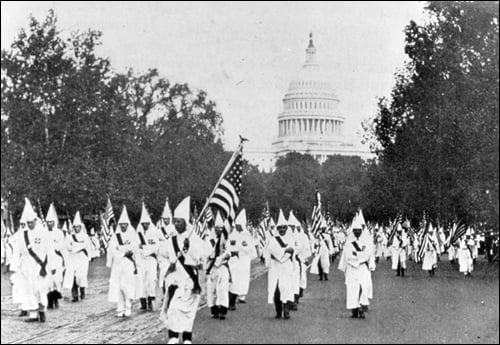
The Bureau has been investigating the criminal activities of white supremacy extremists like Ku Klux Klan members since as early as 1918. Today’s extremists are more challenging than ever. They’re affiliated with a variety of white supremacy groups, and they can be motivated by any number of religious or political ideologies. We’re also seeing more lone offenders and small, violent factions of larger groups at work, which makes detection of these crimes tougher.

White supremacy extremists specifically target racial, ethnic, and religious minorities; the federal government; and in some instances, even each other. Their tactics include assault, murder, threats and intimidation, and bombings. They also commit other kinds of crimes—like drug trafficking, bank and armored car robberies, and counterfeiting—to fund their hate-filled activities.

Over the years, the federal government has successfully charged white supremacy extremists using a number of federal statutes, including civil rights violations, racketeering, solicitation to commit crimes of violence, firearms violations, explosives violations, counterfeiting and forgery, and witness tampering.
In recent months, the FBI has led or participated in a number of significant investigations involving violence or attempted violence by self-admitted white supremacists. A few examples:

■In February 2012, an Arizona man was sentenced to federal prison after pleading guilty to possessing and transporting improvised explosive devices near the U.S.-Mexico border.
■In January 2012, the last of four Arkansas defendants charged with firebombing the home of an interracial couple was sentenced to federal prison.
■In December 2011, a Washington man was sentenced to 32 years in prison for attempting to bomb a Martin Luther King, Jr. Unity Day march in Spokane.
■In May 2010, an Oregon man pled guilty to mailing a hangman’s noose to the home of the president of a local NAACP chapter in Ohio.

Moving forward, we see three keys to turning back the ongoing scourge of white supremacy extremism:

■Our increased emphasis on the lawful gathering, analyzing, and sharing of intelligence on current and emerging trends, tactics, and threats.
■Continued collaboration with our local, state, tribal, and federal partners, especially on our Joint Terrorism Task Forces around the nation.
■And most importantly, the support of Americans who find these types of crimes abhorrent and antithetical to our way of life.

If you have information on domestic terror threats of any kind, submit a tip or contact your local FBI field office.

Monday, March 05, 2012

Ohio Man Pleads Guilty to Cross Burning

WASHINGTON—Brandon Rhodes, 20, of Marengo, Ohio, pleaded guilty yesterday to a charge related to the burning of a cross in the yard of an African-American juvenile in March 2011, the Justice Department announced today.

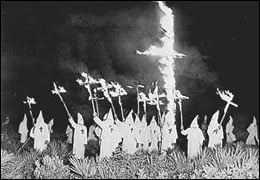
Rhodes pleaded guilty to conspiracy to interfere with the housing rights of another in federal court in Columbus, Ohio before U.S. District Judge Gregory L. Frost. Information presented during the plea hearing established that a cross burning occurred on March 2, 2011 at a residence in Bennington Township, Ohio that was home to an African-American family with three high school children. The investigation revealed that Rhodes and his co-conspirator agreed to burn a cross in the backyard of the home of one of the children who resided there. After the six-foot wooden cross was constructed, Rhodes and his co-conspirator transported the cross to the back yard of the African-American family. Rhodes and his co-conspirator wrote “KKK will make you pay” and another racial, derogatory term on the cross. Rhodes and his co-conspirator poured gasoline on the cross and, using a cigarette lighter, ignited the cross around midnight.

“A burning cross is a symbol of bigotry and hate and, in this case, it was used to threaten a family. These incidents have no place in our country, and they are a reminder of the civil rights challenges we still face today,” said Thomas E. Perez, Assistant Attorney General for the Civil Rights Division. “We will continue to aggressively prosecute hate crimes of this kind.”

“We are committed to working with federal, state, and local law enforcement to investigate and prosecute those who commit crimes driven by intolerance or hatred,” said Carter Stewart, U.S. Attorney for the Southern District of Ohio.

Rhodes faces a maximum penalty of 10 years in prison and a $250,000 fine.

The case was investigated by the FBI. The case is being prosecuted by Assistant U.S. Attorney Kenneth L. Parker from the U.S. Attorney’s Office for the Southern District of Ohio and Trial Attorney Patricia A. Sumner from the Civil Rights Division of the Department of Justice.

Monday, January 30, 2012

Arkansas Men Sentenced in Cross-Burning Case

WASHINGTON—Bradley Branscum, 23, and Tony Branscum, 26, who are first cousins, of Salado, Ark., and Curtis Coffee, 19, of Batesville, Ark., were sentenced for charges relating to their roles in burning a cross in the yard of an African-American resident on Aug. 28, 2010. Tony Branscum was sentenced on Jan. 20, 2012, to 18 months in prison. Bradley Branscum and Curtis Coffee were sentenced today. Bradley Branscum was sentenced to seven months in prison and Curtis Coffee was sentenced today to 18 months in prison.

On Aug. 28, 2010, the three men and a juvenile constructed a cross, placed it in the yard of an African-American resident of Salado, and lit it on fire. The defendants then drove away. The resident did not suffer injury, and his home was not damaged. All three men had previously pleaded guilty in this case to interfering with the housing rights of another.

“The defendants acted to instill fear because of the victim’s race,” said Thomas E. Perez, Assistant Attorney General for the Civil Rights Division. “The Department of Justice remains committed to protecting our communities from such violence and will continue to aggressively prosecute these acts.”

This case was investigated by the FBI and prosecuted by AUSA John Ray White, of the U.S. Attorney’s Office, and Trial Attorney Cindy Chung of the Civil Rights Division.

Saturday, January 28, 2012

Arkansas Men Sentenced in Cross-Burning Case

WASHINGTON – Bradley Branscum, 23, and Tony Branscum, 26, who are first cousins, of Salado, Ark., and Curtis Coffee, 19, of Batesville, Ark., were sentenced for charges relating to their roles in burning a cross in the yard of an African-American resident on Aug. 28, 2010.   Tony Branscum was sentenced on Jan. 20, 2012, to 18 months in prison.   Bradley Branscum and Curtis Coffee were sentenced today.   Bradley Branscum was sentenced to seven months in prison and Curtis Coffee was sentenced today to 18 months in prison.  

On Aug. 28, 2010, the three men and a juvenile constructed a cross, placed it in the yard of an African-American resident of Salado and lit it on fire.   The defendants then drove away.   The resident did not suffer injury, and his home was not damaged.   All three men had previously pleaded guilty in this case to interfering with the housing rights of another.

 “The defendants acted to instill fear because of the victim’s race,” said Thomas E. Perez, Assistant Attorney General for the Civil Rights Division.   “The Department of Justice remains committed to protecting our communities from such violence and will continue to aggressively prosecute these acts.”

This case was investigated by the FBI and prosecuted by AUSA John Ray White, of the U.S. Attorney’s Office and Trial Attorney Cindy Chung of the Civil Rights Division.

Thursday, January 26, 2012

Two Men Sentenced for Racially Motivated Assault in New Mexico

First Defendants Charged Under the Matthew Shepard and James Byrd Jr. Hate Crimes Prevention Act

WASHINGTON—Paul Beebe and Jesse Sanford of Farmington, N.M., were sentenced today in U.S. District Court in Santa Fe, N.M., on federal hate crime charges related to a racially motivated assault on a 22-year-old developmentally disabled man of Navajo descent, the Department of Justice announced. Beebe was sentenced to eight-and-a-half years in prison followed by three years’ supervised release. Sanford was sentenced to five years in prison followed by three years’ supervised release. A third defendant, William Hatch, of Fruitland, N.M., previously pleaded guilty in June 2011 to conspiracy to commit a federal hate crime. Hatch has not yet been sentenced.

Beebe, Hatch, and Sanford were indicted by a federal grand jury in November 2010 on one count of conspiracy and one count of violating the Matthew Shepard and James Byrd Jr. Hate Crimes Prevention Act (Shepard/Byrd Act). They were the first defendants ever to be charged under this law, which was enacted in October 2009. Beebe pleaded guilty to one count of violating the Shepard/Byrd Act, and Sanford pleaded guilty to one count of conspiracy to commit a violation of the Shepard/Byrd Act.

“The sentence imposed today by the court reflects the hateful and heinous nature of the defendants’ actions, and serves as a reminder of courage of the victim who survived those acts and reported these crimes,” said Thomas E. Perez, Assistant Attorney General for the Civil Rights Division. “The Justice Department will not tolerate violent racially motivated assaults and will continue to work cooperatively with our state and local partners to aggressively enforce the Shepard/Byrd Hate Crimes Prevention Act.”

“Today the court sentenced Paul Beebe and Jesse Sanford to significant terms of imprisonment for the inexcusable crime of assaulting, branding, and scarring a young man simply because he happened to be a Native American,” said Kenneth J. Gonzales, U.S. Attorney for the District of New Mexico. “Violence motivated by racial or ethnic hatred exacerbates fear and tears at the fabric of our society. Here in New Mexico, where we celebrate our ethnic, racial, and cultural diversity, I will continue to work with the FBI to vigorously investigate and prosecute acts of violence that are motivated by hatred of another’s race or ethnic heritage.”

“Today’s sentencing is the result of the hard work of FBI special agents and our law enforcement partners, who were committed to pursuing justice until the perpetrators of this hate crime answered for their actions. But the fight against acts of hatred and intolerance goes on,” said Carol K.O. Lee, Special Agent in Charge of the Albuquerque Division of the FBI. “The Albuquerque FBI Division will continue to work with our federal, state and local law enforcement colleagues to investigate hate crimes, the number one priority of our civil rights program.”

During their plea hearing in August 2011, Beebe and Sanford admitted that Beebe took the victim to his apartment, which was adorned in racist paraphernalia, including a Nazi flag and a woven dream catcher with a swastika in it. After the victim had fallen asleep, the defendants began defacing the victim’s body by drawing on him with blue, red, and black markers. Once the victim awoke, Beebe branded the victim, who sat with a towel in his mouth, by heating a wire hanger on a stove and burning the victim’s flesh, causing a permanent deep impression of a swastika in his skin. The defendants used a cell phone to create a recording of the victim in which they coerced him to agree to be branded.

The defendants also admitted that they defaced the victim’s body with white supremacist and anti-Native American symbols, including shaving a swastika in the back of the victim’s head and using markers to write the words “KKK” and “White Power” within the lines of the swastika. The defendants further mocked the victim’s heritage by drawing an ejaculating penis and testicles on the victim’s back, telling him that they were drawing his “native pride feathers,” all the while recording the incident on a cell phone to later play for law enforcement, as “proof” that the victim consented to their acts.
The prosecution of these defendants was the result of a cooperative effort between the U.S. Attorney’s Office for the District of New Mexico, the U.S. Department of Justice Civil Rights Division and the San Juan, N.M., County District Attorney’s Office. This case was investigated by the Albuquerque Division of the FBI in cooperation with the Farmington Police Department. It is being prosecuted by Assistant U.S. Attorney Roberto Ortega for the District of New Mexico and Special Litigation Counsel Gerard Hogan and Trial Attorney Fara Gold of the Civil Rights Division.

Tuesday, July 19, 2011

Two Arkansas Men Plead Guilty to Federal Hate Crime for Cross Burning

WASHINGTON—Tony Branscum, 25, and James Bradley “Brad” Branscum, 23, both of Salado, Ark., pleaded guilty today to criminal violations of housing rights related to their role in the Aug. 28, 2010, cross burning in front of an African-American man’s apartment in Salado, the Department of Justice announced.

The two men, who are first cousins, along with co-defendant, Curtis Coffee, 19, also of Salado, were indicted in November 2010, by a federal grand jury on civil rights charges and other related federal charges stemming from their participation in the cross burning.

Both Branscums admitted in court that on the night of Aug. 28, 2010, they, along with Coffee, devised a plan to burn a cross in the yard of an African-American in the Salado community. Thereafter, Tony Branscum constructed a wooden cross in a workshop behind his house. The men then covered the cross in gasoline-soaked clothing and Brad Branscum drove them and the cross to the victim’s residence. Upon arriving at the residence, one of the men propped up the cross on a satellite dish and ignited it.

“Interfering with a person’s housing rights because of his race will not be tolerated in our country,” said Thomas E. Perez, Assistant Attorney General for the Civil Rights Division. “The Justice Department will vigorously prosecute individuals that violate the rights of others because of race.”

Both Tony and Brad Branscum face up to 10 years in prison and fines of up to $250,000.

This case was investigated by the Little Rock, Ark., Division of the FBI and is being prosecuted by Assistant U.S. Attorney John Ray White of the Eastern District of Arkansas and Trial Attorneys Cindy Chung and Henry Leventis of the Civil Rights Division.

Friday, July 15, 2011

Former Klansman Who Traveled to Georgia for Sex With Two Underage Girls Sentenced to 20 Years in Prison

Defendant Drove from St. Louis to Atlanta for Rendezvous

ATLANTA, GA—NEAL RAY SCHMIDT, 59, of St. Louis, Missouri, was sentenced today to serve 20 years in federal prison for seeking to have sex with two teenage girls. SCHMIDT, a retired delivery man and former Grand Dragon for the Missouri chapter of the Ku Klux Klan, had traveled from Missouri to Georgia for what he hoped would be a sexual encounter with two 14 year-old girls he met on-line. Since his arrest in this case, SCHMIDT has been charged with molesting his granddaughter in Missouri and with arranging a similar sexual encounter with an underage girl in Florida.

“This case starkly illustrates how the Internet can expose our children not only to the predator down the street, but also to the would-be molester who lives hundreds of miles away. Thanks to the hard work of one of our local law enforcement partners, this particular offender will now be kept away from any other potential victims for many years to come,” said United States Attorney Sally Quillian Yates.

“I think that it is great that this individual will be off the streets and out of our communities for quite some time. I am very proud of our Internet Crimes Against Children (ICAC) unit and the professionalism they displayed during this investigation. The teamwork utilized by all the agencies involved proved to be very instrumental in the successful prosecution of this case and is a shining example of what we can accomplish when we work in that capacity,” said Henry County Police Department Chief Keith Nichols.

United States District Court Judge William S. Duffey, Jr., sentenced SCHMIDT to 20 years in prison, to be followed by a lifetime of supervised release. SCHMIDT will be required to register as a sex offender upon his release from custody. SCHMIDT was arrested in June 2010 and pleaded guilty to the charges in April 2011.

According to United States Attorney Yates, the charges and other information presented in court: In early 2010, SCHMIDT, while trolling in an on-line forum for kids, met whom he believed to be two 14 year-old girls but who were in fact undercover police officers. The two girls claimed to be friends and explained that they lived near each other in McDonough, Georgia. SCHMIDT and the girls had a series of mundane exchanges until SCHMIDT turned the conversation toward sexual topics. Over the ensuing months, in an effort to groom the girls for an eventual sexual encounter, SCHMIDT sent sexually explicit videos of himself, as well as images and videos of child pornography.

In June 2010, SCHMIDT made arrangements to drive from his home near St. Louis to a motel in McDonough, Georgia, where the two girls were to meet him for their sexual encounter. SCHMIDT was arrested in the parking lot of the motel in McDonough, carrying several guns, Klan paraphernalia, and an assortment of sex toys and supplies.

This case was investigated by the Henry County Police Department, with assistance from the FBI.

Assistant United States Attorney Robert McBurney prosecuted the case.

For further information please contact Sally Q. Yates, United States Attorney, or Charysse L. Alexander, Executive Assistant United States Attorney, through Patrick Crosby, Public Affairs Officer, U.S. Attorney’s Office, at 404-581-6016. The Internet address for the HomePage for the U.S. Attorney’s Office for the Northern District of Georgia is www.justice.gov/usao/gan.

Wednesday, May 11, 2011

Pennsylvania Man Pleads Guilty for Cross Burning

WASHINGTON – Michael Duane Bracken, of Bolivar, Penn., pleaded guilty today to a charge related to the burning of a cross in the yard of an African-American juvenile in November 2009, the Justice Department announced today.   Bracken is the last of three adult defendants to enter a guilty plea in the case, following Michael Francis Bealonis and Kenneth Paul Stiffey Jr. 

Bracken, 23, pleaded guilty to conspiracy to interfere with the housing rights of another in federal court in Pittsburgh before Senior U.S. District Judge Alan N. Bloch.   Information presented during the plea hearing established that Bracken and his co-conspirators agreed to burn a cross at a home of a family with three minor children, one of whom is African-American.   Bracken was principal in constructing the cross on Nov. 14, 2009, and burning a smaller “practice cross” to assess how it would burn.   After the 6-foot wooden cross was constructed and doused in accelerant, Bracken and others applied gasoline to the cross.   One of the co-conspirators then took the cross, jumped the fence onto the backyard of the victim’s property, stuck it into the ground and ignited it.

“The burning cross is an unmistakable symbol of bigotry and hate, and to use it to threaten a family with violence because the race of a child is intolerable in this nation. That such incidents occur in 2011 is a reminder of the civil rights challenges we still face,” said Thomas E. Perez, Assistant Attorney General for the Civil Rights Division. “We will continue to aggressively prosecute hate crimes of this kind.”

“This case underscores our commitment to vigorously pursue those who commit crimes driven by hatred or intolerance,” stated U.S. Attorney for the Western District of Pennsylvania, David J. Hickton.

Judge Bloch remanded Bracken to the custody of the U.S. Marshals pending sentencing, which has been set for Sept. 1, 2011.   The law provides for a maximum punishment of 10 years in prison and a $250,000 fine.

The case was investigated by the FBI, together with the Pennsylvania State Police.   The case is being prosecuted by Assistant U.S. Attorney Soo C. Song from the U.S. Attornery's Office for the Western District of Pennsylvania and Trial Attorney Patricia A. Sumner from the Civil Rights Division of the Department of Justice.

Monday, April 11, 2011

Former O'Fallon Man Indicted for Maliciously Conveying False Threats to City of O'Fallon's City Hall and Police Department

A former O'Fallon resident is charged with conveying false threats to the O'Fallon Police Department and O'Fallon City Hall in November of 2006, the United States Attorney Stephen R. Wigginton announced today. Justin Lamar Kidd, age 28, was indicted by a federal grand jury on March 25, 2011. The grand jury returned an indictment charging Kidd with mailing a letter on or around November 9, 2006, to the O'Fallon Police Department, which stated: "Get all the blacks from Chevy Chase Apartments from out of O'Fallon before we burn the [w]hole complex down. KKK warning," and, then, with mailing another letter on or about November 18, 2006, to the O'Fallon City Hall, which stated: "Get all the blacks out of O'Fallon before we start burning he[ir] houses down." Kidd, an African-American, sent these threats knowing them to be false.

An indictment is a charge against a defendant. Under the law, a defendant is presumed to be innocent until proved guilty beyond a reasonable doubt to the satisfaction of a jury.

Counts 1 and 2 of the indictment charge the offense of conveying false threats in violation of Title 18, United States Code, Section 844(e), which carries a maximum sentence of 10 years' imprisonment, $250,000 fine, or both, and up to three years' supervised release. Kidd's initial appearance before the district court was held in East St Louis on April 7, 2011.

This investigation was conducted by the Federal Bureau of Investigation and the United States Postal Inspection Service, with the assistance of the O'Fallon Police Department. The case is being handled by Assistant United States Attorney Liam Coonan.

Friday, March 18, 2011

Anderson County Man Receives Six-Month Prison Sentence for Cross-Burning

KNOXVILLE, TN—Steven D. Archer, 50, Heiskell, Tennessee, was sentenced today by the Honorable Thomas W. Phillips, U.S. District Judge, to serve six months in federal prison, followed by six months of community confinement. This sentence follows Archer's July 1, 2011, conviction for willfully interfering with a couple’s federal housing rights because of their race by burning a wooden cross outside the Anderson County residence occupied by the victims—a Caucasian female and an African-American male.

The cross-burning occured on July 23, 2008, and the proof at trial demonstrated that Archer built a wooden cross at his place of business and transported it to the front yard of the victims’ residence. The evidence also showed that before setting fire to the cross, Archer wrapped the cross in fuel-soaked cloth and attached .22 caliber blank shells to the cross, which exploded as the cross burned. Archer admitted burning the cross, but denied a racial motivation. A federal court jury found otherwise and convicted Archer of violating the victims’ federal housing rights.

“Cross-burning is a despicable act of hatred and intolerance,” said U.S. Attorney Bill Killian, and further added, “Americans of all races should be free to live where they choose, undisturbed by such deplorable conduct. The Federal Bureau of Investigation and the U.S. Attorney’s Office, in conjunction with the Civil Rights Division, U.S. Department of Justice, will aggresively investigate cross-burnings and all other hate crimes.”

This case was investigated by the Federal Bureau of Investigation. Assistant United States Attorney Trey Hamilton represented the United States.

Wednesday, February 16, 2011

Three Plead Guilty to Civil Rights Conspiracy in Connection with Cross Burning in Athens, Louisiana

WASHINGTON – The Justice Department announced that U.S. District Judge Donald E. Walter accepted the guilty plea of Jeremy Matthew Moro, 33, for conspiring to burn a cross near the home of an interracial couple in Athens, La., in October 2008. Earlier this week, Judge Walter accepted the guilty plea of Joshua James Moro, 25, on the same charge.

Another defendant, Sonya Marie Hart, 31, pleaded guilty on Jan. 31, 2011, to misprision of a felony because she withheld information from the FBI regarding the defendants’ attempt to cover up the cross burning.   The Moros’ cousin, Daniel Danforth, was previously convicted by a federal jury for organizing, carrying out and attempting to cover up the same cross burning.  

During their pleas, entered before Magistrate Judge Mark L. Hornsby on Jan. 21, and Jan. 26, 2011, Joshua and Jeremy Moro admitted that in October 2008, they agreed with their cousin, Daniel Danforth, to build, erect and burn a cross near the home of another cousin, her African-American boyfriend (now husband), her 11-year-old son and their grandmother who was believed to approve of the cousin’s interracial relationship.   Joshua Moro admitted that he offered Danforth diesel fuel to use to burn the cross, and that later that evening he sent a text message to see if Danforth and Jeremy Moro still needed the diesel to burn the cross.   Jeremy Moro admitted that he helped Danforth find an accelerant, transport the cross to an area near the victims’ homes, and watched Danforth light the cross on fire because Danforth was upset about the presence of the African-American man living with their cousin.   During her plea, on Jan. 31, 2011, Hart admitted that she affirmatively withheld information from the FBI in connection with the investigation into the cross burning and attempted cover-up.  

Evidence during Danforth’s trial in January 2010, showed that in the days following the cross burning, Danforth, Jeremy Moro and Hart agreed to remove the burned cross when they learned that the FBI was going to investigate the matter.   With Jeremy Moro’s and Hart’s assistance, Danforth removed the cross, disassembled it and hid it in the woods.   The evidence also showed that Josh Moro, Jeremy Moro and Hart lied to the FBI and a federal grand jury during the investigation into the cross burning.

“Driven by bigotry and hate, the defendants threatened a member of their own family with violence simply because she associated with persons of another race,” said Thomas E. Perez, Assistant Attorney General for the Civil Rights Division.   “Incidents of this kind have no place in this country, and they are a reminder of the civil rights challenges we still face.”

“Cross burning, unfortunately, remains a terrible symbol of hatred and intolerance.  Every citizen has a right to feel safe and secure in their homes and neighborhoods.  Intimidation of citizens in this district will not be tolerated.  This office will continue to prosecute individuals who participate or facilitate crimes which violate the civil rights laws,” said U.S. Attorney for the Western District of Louisiana Stephanie Finley.  

“All families in America have the right to live where they chose, undisturbed by racial intolerance, racist threats and intimidation. These guilty pleas send a clear message of the FBI’s commitment to aggressively investigate this type of criminal conduct,” said David W. Welker, Special Agent in Charge of the New Orleans Division of the FBI.

Sentencing for Joshua Moro, Jeremy Moro and Hart has been set for April 28, 2011.   Joshua and Jeremy Moro each face a maximum punishment of 10 years for conspiring to interfere with another person’s civil rights.   Hart faces a maximum punishment of three years for affirmatively withholding information from the FBI regarding the defendants’ attempt to cover up the cross burning.   Danforth was sentenced in May 2010 to 48 months in prison for his role in the cross burning and attempted cover-up.

This case was investigated by the FBI.   The case is being prosecuted by Assistant U.S. Attorney Mary J. Mudrick for the Western District of Louisiana and Trial Attorney Erin Aslan from the Justice Department’s Civil Rights Division.

Thursday, December 16, 2010

The FBI Versus the Klan Part 5

Trouble in Texas

A husband and wife chatted as they passed an energy plant in north Texas.

“I hate to be that way, but if it has to be…” the wife said matter-of-factly after she and her husband realized that blowing up the natural gas processing facility would kill many people, including young children at a nearby school.

The year was 1997. The couple belonged a regional extremist group called the True Knights of the Ku Klux Klan and was casing the plant for a Klan operation. Along with two other True Knights, their plan was to build a homemade bomb—like the one used in Oklahoma City two years earlier—and explode it near large storage tanks at the facility. They hoped that the resulting explosion would release a cloud of hydrogen sulfide—so-called “sour gas”—that would kill hundreds of people. The children were just collateral damage.

As grisly as that sounds, it was just the beginning of their plan. The bombing was simply a cover to distract law enforcement while the Klan robbed an armored car of some $2 million on the other side of town. In fact, to add to the chaos and help clear the way for the robbery and getaway, the plot called for detonating a second bomb when law enforcement and first responders arrived at the scene of the explosion.

And the point of the robbery? To raise money to go to war with the U.S. government in the run-up to the millennium, when paranoia among homegrown extremists was rising.

It was no idle talk. “They were building and testing improved explosive devices,” says Special Agent John Fraga, who led the Operation Sour Gas investigation while supervising our North Texas Joint Terrorism Task Force and is now the acting head of the Terrorist Explosive Device Analytical Center in the FBI Laboratory. “They knew how to rupture the tanks.”

What the Klan members didn’t know was that the FBI office in Dallas was well aware of the entire scheme—thanks to a well-placed source within the True Knights. Its multi-agency terror task force was watching the group’s every step and had even bugged the cab of the couple’s truck as they callously dismissed the possible outcome of the attack while driving past the facility.

With plenty of evidence in hand, we arrested all four conspirators in April 1997 before they could carry out their sinister plot. Each pled guilty by early October and was ultimately sentenced to jail.

“This case was one of the Bureau’s first weapons of mass destruction preventions,” says Fraga. And it was yet another successful victory in the FBI’s fight against the KKK, which started in the years prior to World War I and continues to this day.

Over that time, the Klan has continued to morph and change. Today, it’s a shadow of its brazen, lawless self in the 1950s and 1960s—thanks in large part to the dogged work of the FBI and its partners during that era—but as the Texas case demonstrates, the threat remains.

As always, the FBI remains committed to protecting the civil rights of all Americans—whether from crimes of hatred or acts of terror—carried out by the KKK and like-minded extremists. Look to this website in the future for more news and information on this continuing effort…

Tuesday, December 14, 2010

The FBI Versus the Klan Part 4

A Leader Emerges

Roy Moore had seen the Klan in action, and he knew what he was up against.

While head of the FBI's office in Little Rock, he was asked to lead a special squad investigating the KKK's 1963 bombing of the Sixteenth Street Baptist Church, which had killed four African-American girls and injured many more.

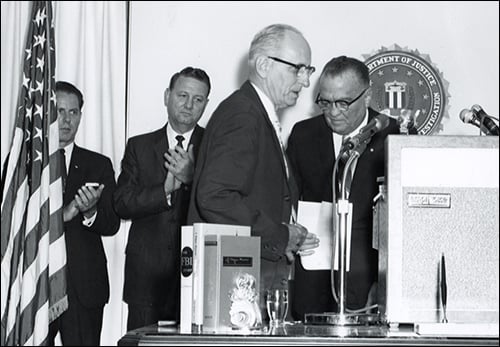
So when the call came on July 2, 1964 from FBI Director J. Edgar Hoover, Special Agent in Charge Moore was ready. Later that afternoon, the historic Civil Rights Act would be signed into law, and President Lyndon B. Johnson had already instructed Hoover's FBI, which was about to gain new authorities, to establish a stronger presence in Mississippi. Hoover chose Moore—a trusted Bureau veteran who'd joined the FBI in 1938 and earned his stripes finding the culprit of a massive mid-air explosion in 1955—to set up a new field office in Jackson.

At the time, Mississippi was the epicenter of violent Klan activity, and Hoover wanted to send a powerful message that the FBI was in business there and was determined to reassert the rule of law. So he asked Moore to make preparations quickly and quietly as part of what Hoover considered a “psychological operation” against the KKK in the state.

The morning after the July 4 holiday, Moore reported to Jackson. A week later, he joined Hoover, the Mississippi attorney general, and others in announcing the formal opening of the office in a rented downtown bank building.

Moore's immediate job was to help solve the KKK-fueled murder of three civil rights workers—James Chaney, Andrew Goodman, and Michael Schwerner—in Neshoba County less than a month earlier. What became known as the infamous “Mississippi Burning” case gained national attention and helped spur the passage of the landmark civil rights bill. With his support, the FBI located the three men's bodies buried under an earthen dam and fingered a series of suspects by year's end.

For Moore, it was just the beginning. Over the next seven years, he spearheaded the Bureau's work to loosen the Klan's stranglehold in Mississippi and restore law and order through a series of investigations and other efforts.

Moore was well respected by the agents who worked with and for him. He was considered a tough, demanding boss but an “outstanding individual” and “one of the great leaders of that time.” According to Special Agent James Ingram, “He expected people to work six-and-a-half days a week ... Sunday mornings were for church and laundry, [but] by you were back to work.”

Moore's leadership made a critical difference in turning the tide against the Klan in the 1960s. He was reassigned to Chicago in 1971, then retired in December 1974—moving back to Mississippi, where he lived out his days. When Moore died in 2008, veteran Mississippi journalist Bill Minor was quoted as saying in a Washington Post obituary, “How close Mississippi stood in the 1960s to being taken over by the law of the jungle is still a frightening thought…There was only one reliable law enforcement agency in Mississippi at the time, and that was the FBI, headed by Roy Moore.”

The FBI Versus the Klan Part 3

Standing Tall in Mississippi

As the civil rights movement began to take shape in the 1950s, its important work was often met with opposition—and more significantly, with violence—by the increasingly resurgent white supremacists groups of the KKK.

FBI agents in our southern field offices were on the front lines of this battle, working to see that the guilty were brought to justice and to undermine the efforts of the Klan in states like Mississippi. That was often difficult given the reluctance of witnesses to come forward and testify in court and the unwillingness of juries to convict Klansmen even in the face of clear evidence.

Fortunately, the struggles and insights of many of these agents have been recorded for posterity, and transcripts are available for review by the general public—thanks to the Society of Former Special Agents of the FBI and the National Law Enforcement Officers Memorial Foundation, which broke ground on a museum earlier this month.

In this story and the next in our Klan series, we’ll highlight a few of these memorable discussions with our agents concerning their work against the KKK. The first comes from FBI Agent James Ingram, who served from 1957 to 1982 and played a key role in many civil rights investigations. Agent Ingram, who died recently, was assigned to the newly opened Jackson Field Office in Mississippi in 1964. A retired agent and colleague in Jackson, Avery Rollins, interviewed Ingram before his death:

Special Agent Rollins: “You said that your average work week was six-and-a-half days. I would assume that your average work day was anywhere from to 12 hours long?”

Special Agent Ingram: “Oh, it was. …That’s why we defeated the Klan. … there was never a defeatist attitude because we were all on the same schedule. And everyone knew that we had to work.”
That work continued following passage of the Civil Rights Act of 1964:

Special Agent Ingram: “There was one thing about [the law], Mr. Hoover knew that it was important. He gave Inspector Joe Sullivan and [Jackson Special Agent in Charge] Roy Moore a mandate. And he said, ‘You will do whatever it takes to defeat the Klan, and you will do whatever it takes to bring law and order back to Mississippi.’”

The threats to FBI agents were real:

“Agents would always watch. They’d look underneath their cars to make sure we did not have any dynamite strapped underneath … Then you’d open your hood and make sure that everything was clear there. We had snakes placed in mailboxes. We had threats.”

But using informants and other tools, the tide began to turn:

-“[W]e infiltrated the Klan in many ways. We had female informants. … And we had police officers that were informants for us.”
-“When you look back, the FBI can be proud that they stopped the violence [of the KKK]. We had the convictions. We did what we had to do from Selma, Alabama to Jackson, Mississippi to Atlanta, Georgia."
-In the words of Special Agent Rollins, “…the FBI broke the back of the Klan in Mississippi. And eradicated it…”

A complete transcript of the interview of James Ingram can be found on the National Law Enforcement Officer Memorial Foundation Museum website, including much more discussion on the Klan. Also see additional FBI oral histories.

The FBI Versus the Klan Part 2

Trouble in the 1920s

The Roaring Twenties were a heady time, full of innovation and exploration—from the novelty of “talking pictures” to the utility of mass-produced Model Ts...from the distinct jazz sounds of Duke Ellington to the calculated social rebellion of the “flappers”...from the pioneering flights of Charles Lindbergh and Amelia Earhart to the pioneering prose of F. Scott Fitzgerald and William Faulkner.

It was also a lawless decade—an age of highly violent and well-heeled gangsters and racketeers who fueled a growing underworld of crime and corruption. Al Capone and his archrival Bugs Moran had formed powerful, warring criminal enterprises that ruled the streets of Chicago, while the early Mafia was crystallizing in New York and other cities, running various gambling, bootlegging, and other illegal operations.

Contributing to criminal chaos of the 1920s was the sudden rise of the Ku Klux Klan, or KKK. In the early 1920s, membership in the KKK quickly escalated to six figures under the leadership of “Colonel” William Simmons and advertising guru Edward Young Clarke. By the middle of the decade, the group boasted several million members. The crimes committed in the name of its bigoted beliefs were despicable—hangings, floggings, mutilations, tarring and featherings, kidnappings, brandings by acid, along with a new intimidation tactic, cross-burnings. The Klan had become a clear threat to public safety and order.

Matters were getting so out of hand in the state of Louisiana that Governor John M. Parker petitioned the federal government for help. In a memo dated September 25, 1922, J. Edgar Hoover—then assistant director of the Bureau—informed Director Burns that a reporter had brought a personal letter from Parker to the Department of Justice. “The Governor has been unable to use either the mails, telegraph, or telephone because of interference by the Klan … Conditions have been brought to a head at Mer Rouge, when two white men … were done away with mysteriously,” Hoover wrote. He also said that the governor was seeking assistance because “local authorities are absolutely inactive” and because he feared judges and prosecuting attorneys had been corrupted.

The Department responded, immediately sending four Bureau agents—A. E. Farland, J. D. Rooney, J. P. Huddleston, and W. M. Arkens—to work with the Louisiana attorney general to gather evidence of state and federal crimes. The agents soon found the bodies of the two men and pinpointed members of the vigilante mob that kidnapped and brutally murdered them. They also identified the mob’s leader—Dr. B.M. McKoin, the former mayor of Mer Rouge

The agents' work put their own lives in danger. On November 13, 1922, an FBI Headquarters memo noted that “confirmation has just been received of the organized attempt of klansmen and their friends to arrest, kidnap, and do away with special agents of the Department who were in Mer Rouge.” To make matters worse, the plot was “stimulated by the United States Attorney at Shreveport,” reportedly an active KKK member. The U.S. attorney had already ordered the investigating agents, detailed from the Houston Division, to leave the area or be arrested because he thought they had no business investigating those matters. “Only their hurried exit saved them,” the memo said. Still, the agents continued their work.

In 1923, McKoin was arrested and charged with the murders of the two men. Despite National Guard security, witnesses were kidnapped by the Klan, and other attempts were made to sabotage the trial. The grand jury refused to return an indictment. Other KKK members, though, ended up paying fines or being sentenced to short jail terms for miscellaneous misdemeanors related to the murders.

Despite the Bureau’s work, the power of the KKK in certain places was too strong to crack. But as revelations of leadership scandals spread and figures like Edward Young Clarke went to jail, the Klan’s membership dropped off precipitously. By the end of the decade, thanks in part to the Bureau, the KKK had faded into the background—at least for a time.

The FBI Versus the Klan Part 1

Let the Investigations Begin

Ninety-five years ago this month—in February 1915—the D.W. Griffith movie later titled The Birth of a Nation premiered in a Los Angeles theater. Though considered progressive in its technique and style, the film had a decidedly backwards plot that glorified a short-lived, post-Civil War white supremacist group called the Ku Klux Klan. The movie’s broad release in March provoked riots and even bloodshed nationwide.

It also revived interest in the KKK, leading to the birth of several new local groups that summer and fall. Many more followed, mostly in southern states at first. Some of these groups focused on supporting the U.S. effort in World War I, but most wallowed in a toxic mix of secrecy, racism, and violence.

As the Klan grew, it attracted the attention of the young Bureau. Created just a few years earlier—in July 1908—the Bureau of Investigation (as the organization was known then) had few federal laws to combat the KKK in these formative days. Cross burnings and lynchings, for example, were local issues. But under its general domestic security responsibilities, the Bureau was able to start gathering information and intelligence on the Klan and its activities. And wherever possible, we looked for federal violations and shared information with state and local law enforcement for its cases.
Our early files show that Bureau cases and intelligence efforts were already beginning to mount in the years before 1920. A few examples:

-In Birmingham, a middle-aged African-American—who fled north to avoid serving in the war—was arrested for draft dodging in May 1918 when he returned to persuade his white teenage girlfriend to marry him. A Bureau agent looking into the matter discovered that the local KKK had gotten wind of the interracial affair and was organizing to lynch the man. The agent came up with a novel solution to resolve the draft-dodging issue and to protect the man from harm: he escorted the evader to a military camp and ensured that he was quickly inducted.
-In June 1918, a Mobile agent named G.C. Outlaw learned that Ed Rhone—the leader of a multi-racial group called the Knights of Labor—was worried by the abduction of another labor leader by reputed Klansmen. “This uneasiness of the Knights of Labor,” our agent noted, “is the first direct result of the Ku Klux activities.” Agent Outlaw investigated and assured Rhone we would protect him from any possible harm.
-At the request of a Bureau agent in Tampa, a representative of the American Protective League—a group of citizen volunteers who helped investigate domestic issues like draft evasion during World War I—convinced an area Klan group to disband in August 1918.
World War I effectively came to an end with the signing of a ceasefire in November 1918, but the KKK was just getting started. Pro-war oriented Klan groups either folded or began to coalesce around a focus on racial and religious prejudice. Teaming up with advertising executive Edward Young Clarke, the head of the Atlanta Klan—William Simmons—would oversee a rapid rise in KKK membership in the 1920s.

That’s another story, and one that we will tell as part of this new history series detailing the work of the FBI to protect the American people—especially minorities and other groups—from the evils of the modern-day Klan. Over the course of the year, we will track the major aspects of this fight, with new documents and pictures to help tell the tale. Stay tuned.